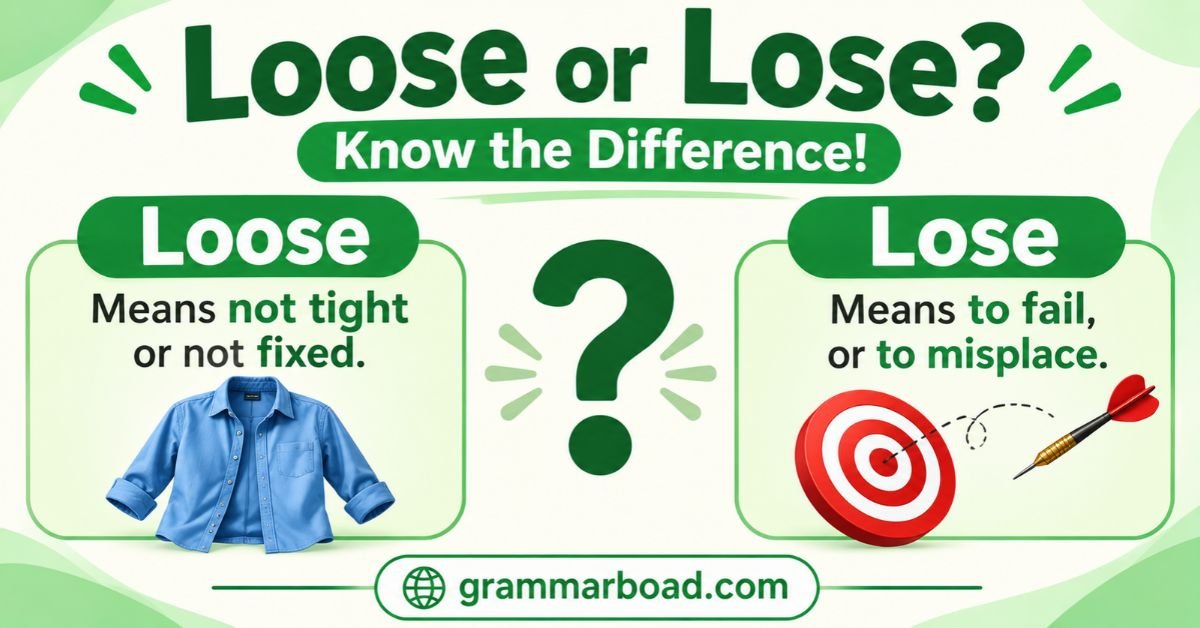
You are typing a quick message and stop mid-sentence: is it “I don’t want to loose my keys” or “I don’t want to lose my keys”? You are not alone. A few word pairs confuse native speakers and English learners as often as loose and lose. The two words look almost identical, sound somewhat similar, and show up constantly in everyday writing.Understanding loose or lose is important because using the wrong spelling can change the meaning of your sentence.
The good news is that the difference is simple once you see it. Lose is a verb that means to misplace something or fail to win. Loose is mostly an adjective that means not tight or not fastened. In this guide, you will find five easy rules, plenty of examples, memory tricks, and a short quiz to lock the difference in for good.
Loose or Lose – Quick Answer
Here is the short version:
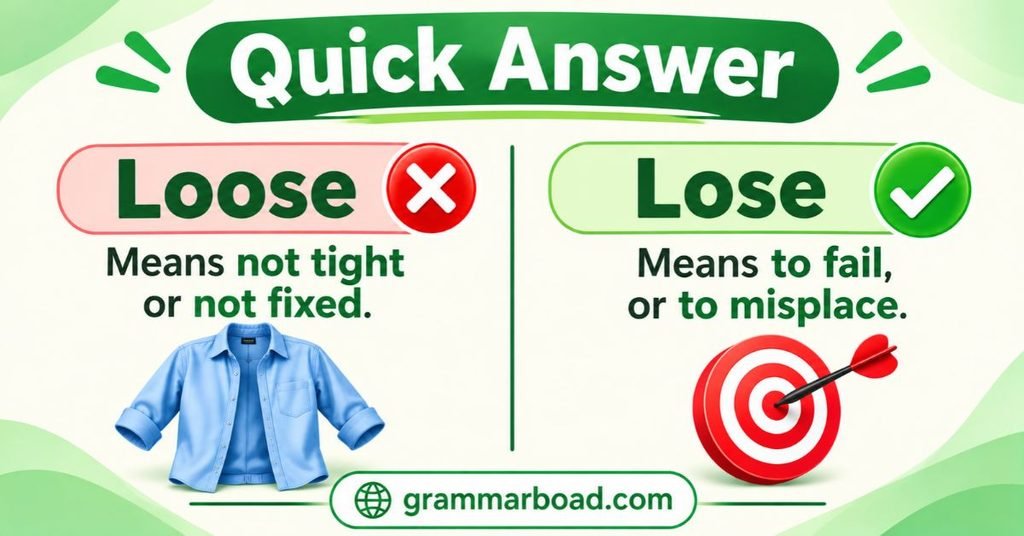
- Lose (rhymes with “choose”) is a verb. It means to misplace something, fail to win, or no longer have something. Example: I always lose my umbrella.
- Loose (rhymes with “goose”) is usually an adjective. It means not tight, not firmly attached, or not restrained. Example: This screw is loose.
If you can replace the word with “misplace,” “fail to win,” or “stop having,” you need lose. If you mean “not tight” or “not attached,” you need loose.When comparing loose or lose, always remember that lose describes an action, while loose describes a condition or state.
The Origin of Loose or Lose
Both words have Germanic roots, but they entered English through different historical forms. Lose developed from Old English losian, meaning to perish or become lost, while loose came into English from Old Norse lauss, meaning free or unfastened. Over time, their spellings and meanings developed differently, making them easy to confuse today.
Over the centuries, spelling and pronunciation shifted, and the two words ended up looking nearly identical despite having different meanings and different histories. Their similar appearance is a quirk of English spelling rather than a sign that they are related in meaning.
What Does Loose Mean in English?
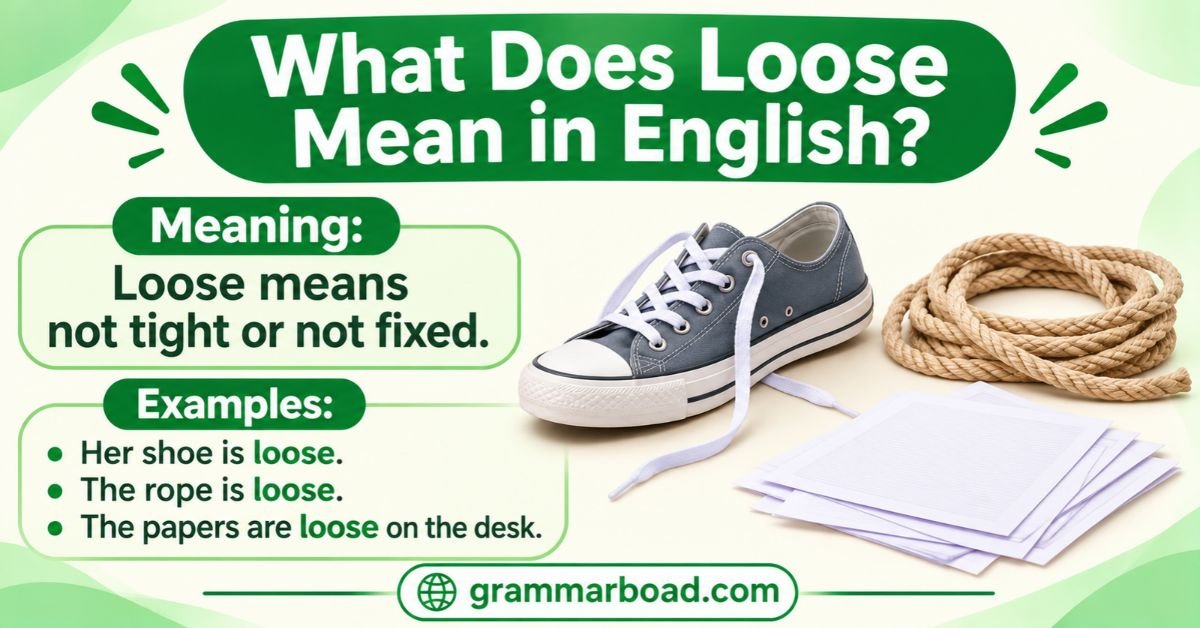
Loose mainly describes something that is not firmly fixed, tight, or contained. You will most often meet it as an adjective, but it also has uses as a verb and, less commonly, as an adverb.
Common meanings of loose:
- Not tight: a loose shirt, loose trousers
- Not firmly attached: a loose tooth, a loose button
- Free or unrestrained: a dog that got loose
- Not exact: a loose translation, a loose definition
- Not packed together: loose change, loose tea leaves
Examples:
- The handle on this drawer is loose.
- She prefers loose clothing in summer.
- Someone left the gate open, and the horses got loose.
What Does Lose Mean in English?
Lose is a verb. It describes the act of no longer having something, failing to succeed, or being deprived of something.
Common meanings of lose:
- Misplace something: I always lose my glasses.
- Fail to win: Our team might lose the final.
- Have something taken away or reduced: He could lose his job.
- Waste or fail to keep: Don’t lose hope.
- Become unable to find your way: We lost the trail in the fog.
Forms of lose: lose, loses, losing, lost. Notice that the past tense is lost, and the present participle is losing, with only one “o.”
Loose vs Lose: Difference in Meaning and Usage
The core difference is one of grammar and meaning. Lose is an action. Loose is a description.
| Lose | Loose | |
| Main word type | Verb | Adjective (also verb, adverb) |
| Core meaning | To misplace, fail to win, or no longer have | Not tight, not fixed, not restrained |
| Pronunciation | /luːz/ (rhymes with “choose”) | /luːs/ (rhymes with “goose”) |
| Example | Don’t lose your passport. | The strap is loose. |
A helpful test is to ask what job the word does in the sentence. If it is something someone does or experiences, use lose. If it describes how something is, use loose.
British English vs American English Spelling
Here is a pleasant surprise: there is no British versus American difference for these two words. Unlike colour/color or organise/organize, loose and lose are spelled exactly the same way in the UK, the US, Canada, and Australia.
That means the confusion is not caused by regional variation. It is simply a common error that happens everywhere, which is why mastering the distinction helps no matter which variety of English you write in.
Which Spelling Should You Use?
Choose based on meaning, not on preference:
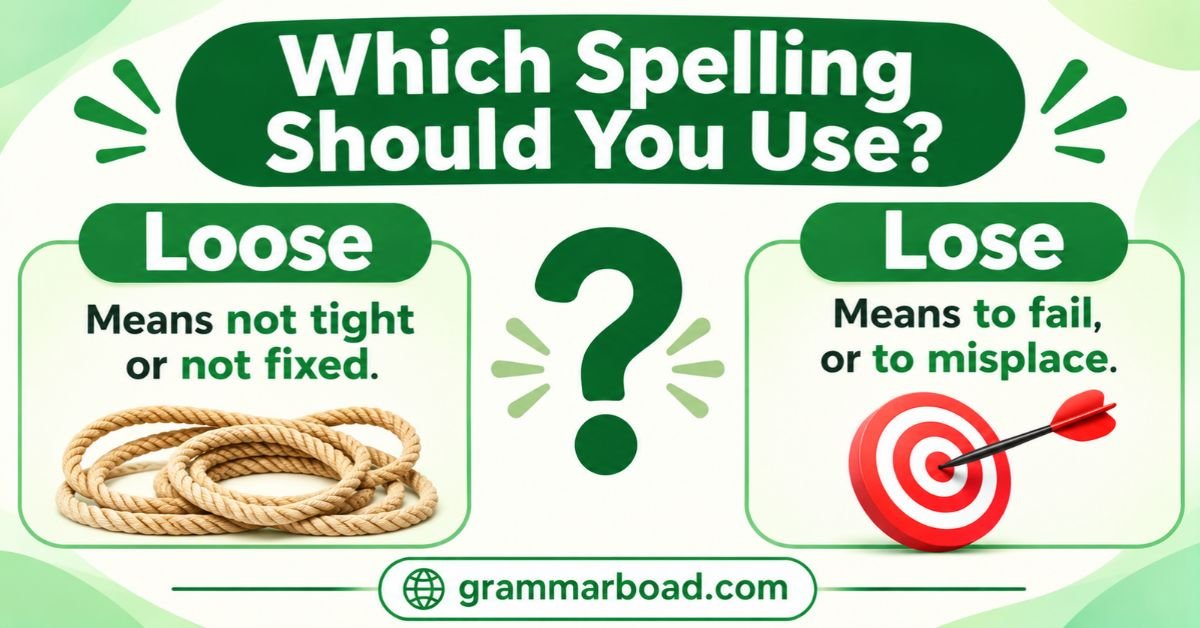
- Use lose when you need a verb meaning to misplace, fail to win, or no longer possess.
- Use loose when you need a word meaning not tight, not attached, or not restrained.
Quick check: if your sentence works with “misplace” or “fail to win,” pick lose. If it works with “not tight” or “free,” pick loose.
How to Remember the Difference Between Loose and Lose
Here are five easy rules and memory tricks you can rely on:
- The extra “o” rule: Loose has more “o”s, and a loose thing has more room. A loose shirt has extra space, and the word has an extra letter.
- The “lost” link: Lose and lost both have a single “o.” If you can swap in lost or losing, you want lose.
- The rhyme rule: Loose rhymes with goose and noose. Lose rhymes with choose and shoes.
- The verb test: If the word is an action, it is lose. If it describes something, it is loose.
- The “s” sound test: Loose ends with a sharp “s” sound, like a hissing release. Lose ends with a “z” sound.
Common Mistakes with Loose or Lose

The most frequent error is writing loose when the writer means lose. Here are typical examples and fixes:
- ❌ I don’t want to loose my job. ✅ I don’t want to lose my job.
- ❌ Don’t loose hope. ✅ Don’t lose hope.
- ❌ The knot came lose. ✅ The knot came loose.
- ❌ He has a lose tooth. ✅ He has a loose tooth.
- ❌ We might loosing the match. ✅ We might lose the match. (or: We are losing the match.)
Another frequent slip is spelling the participle as “loosing” when you mean “losing.” Note that loosing is a real word, but it means releasing or setting free, which is rarely what people intend.
Loose or Lose in Everyday Examples
You will see these words in daily life more often than you might think:
- At work: “We can’t afford to lose this client.” / “Let’s keep the agenda loose so the team can adapt.”
- In sports: “They never want to lose at home.” / “The ball was loose in the penalty area.”
- At home: “I lose my phone every morning.” / “The cabinet door is loose.”
- In fashion: “A loose sweater is perfect for autumn.” / “I don’t want to lose my scarf again.”
- In health and fitness: “She wants to lose weight gradually.” / “Wear loose clothing while you stretch.”
Loose or Lose in Sentences: 15 Examples
Sentences with lose:
- I hope we don’t lose the game tonight.
- Please don’t lose your ticket.
- He tends to lose his temper in traffic.
- You will lose time if you take the long route.
- She was afraid she would lose her way in the old city.
- Don’t lose heart; you are doing well.
- Many plants lose their leaves in autumn.
Sentences with loose:
- The screw on the hinge has come loose.
- She wore a loose cotton dress.
- A few loose papers were scattered across the desk.
- The puppy broke loose from its leash.
- He gave me a loose estimate of the cost.
- Keep a little loose change for the parking meter.
- The tooth is loose and will fall out soon.
Sentence with both words:
- If that strap stays loose, you might lose your bag.
Loose and Lose: Pronunciation Differences
The spelling is similar, but the pronunciation is what truly separates the two words:
- Lose is pronounced /luːz/. The final sound is a “z,” like the end of choose.
- Loose is pronounced /luːs/. The final sound is an “s,” like the end of goose.
The vowel sound is the same in both: a long “oo.” The only difference is the final consonant. If you say the words aloud, the “z” or “s” ending can guide you to the correct spelling.
Is Loose an Adjective or a Verb?
Loose is most commonly an adjective: a loose button, loose clothing, a loose grip.
It can also be used as a verb, though less often, meaning to release or set free:
- The archer loosed an arrow.
- The guards loosed the dogs.
It also appears occasionally as an adverb in informal or fixed expressions, such as “to hang loose” or “to play fast and loose.” For everyday writing, treating it as an adjective will cover nearly every situation.
Is Lose a Verb or an Adjective?
Lose is a verb only. It is never an adjective.
The related adjective is lost, as in “a lost child” or “a lost cause.” The word loser is a noun formed from lose, and losing can act as an adjective in phrases like “a losing streak.” But the base word lose always functions as a verb.
Loose vs Lose: Synonyms and Related Words
Synonyms for lose:
- Misplace
- Mislay
- Forfeit
- Drop (as in “drop a point”)
- Be defeated
- Waste
Synonyms for loose:
- Slack
- Baggy
- Unfastened
- Untied
- Free
- Roomy
- Imprecise (for the “not exact” sense)
Related words to know:
- Lost: past tense and past participle of lose
- Losing: present participle of lose
- Loosen: to make something less tight
- Loosely: in a way that is not tight or precise
Loose or Lose – Google Trends & Usage Data

Google Trends can help compare search interest in “loose” and “lose” over time. You can also compare related spelling searches, such as “affect or effect” and “their or there.” Keep in mind that Google Trends shows relative search interest rather than exact search volumes. This information can help readers understand how frequently people search for commonly confused English words.
Loose vs Lose – Comparison Table
| Feature | Lose | Loose |
| Part of speech | Verb | Adjective (sometimes verb or adverb) |
| Meaning | Misplace, fail to win, no longer have | Not tight, not fixed, free |
| Pronunciation | /luːz/ | /luːs/ |
| Rhymes with | choose, shoes | goose, noose |
| Related forms | loses, losing, lost | looser, loosest, loosen, loosely |
| Example | I might lose my keys. | The rope is loose. |
| Common error | Writing “loose” instead | Writing “lose” instead |
Practice Quiz: Loose or Lose? Test Your Grammar
Choose the correct word for each sentence. Answers are at the end.
- I always ______ my umbrella when it rains.
- This bracelet is too ______ for my wrist.
- Don’t ______ your focus now.
- The horse got ______ from the stable.
- They are afraid they will ______ the championship.
- She wore a ______ jacket over her dress.
- If you leave the bolt ______, the shelf might fall.
- How can I ______ weight in a healthy way?
- The lid is ______, so be careful.
- I can’t ______ you now; you mean too much to me.
Answers:
- lose
- loose
- lose
- loose
- lose
- loose
- loose
- lose
- loose
- lose
Also Read This:https://grammarboad.com/laughing-emoji-meaning/
FAQs
Is it “loose” or “lose” when talking about weight?
Use lose. You lose weight, never “loose” weight.
Is it “loose” or “lose” a game?
Use lose. You lose a game, a match, or a bet.
Can “loose” ever be a verb?
Yes, though it is uncommon. It means to release or set free, as in “to loose an arrow.”
What is the past tense of lose?
The past tense is lost, as in “I lost my wallet yesterday.”
Is “loosing” a real word?
Yes, but it means releasing or setting free. If you mean failing to win or misplacing something, the correct form is losing.
What is the easiest way to remember the difference?
Loose has an extra “o,” just as a loose item has extra room. Lose has only one “o,” like lost.
Do British and American English spell these words differently?
No. Both varieties use the same spellings and meanings.
Conclusion
The difference between loose and lose comes down to a few simple ideas. Lose is a verb meaning to misplace, fail to win, or no longer have something. Loose is usually an adjective meaning not tight, not fastened, or not restrained. The words are spelled the same in British and American English, and the pronunciation difference is just the final sound: “z” for lose and “s” for loose.
Keep the extra “o” trick in mind, test your sentence with lost or losing, and say the word aloud if you are unsure.For more details about the meaning and usage of lose, visit the Merriam-Webster Dictionary. With a little practice, you will stop second-guessing this pair and write with confidence every time.