Vender vs Vendor – which spelling is correct? If you have ever paused while writing an email or business document, you are not alone. Both spellings may look correct, but vendor is the standard and widely accepted spelling in modern English. In this guide, you will learn the difference between the two, understand their meanings, and discover five easy tips to avoid spelling mistakes.
The short version is that “vendor” is the standard spelling in modern English. This guide explains why, where “vender” still shows up, and five practical tips to help you choose the right word every time.
Vender or Vendor – Quick Answer
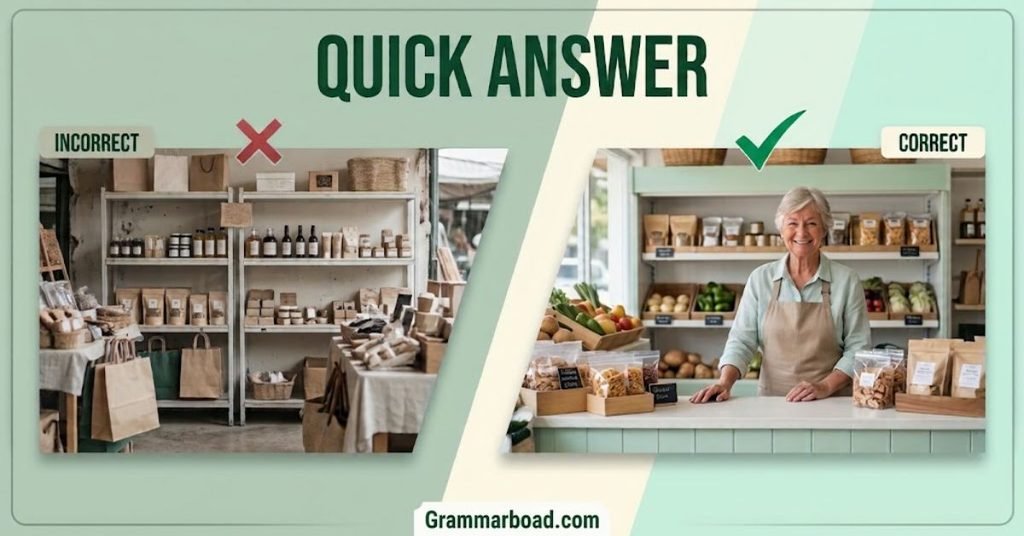
Vendor is the correct and preferred spelling in both American and British English. It refers to a person or company that sells goods or services.
Vender is an uncommon variant. It appears mainly in older texts and in some legal contexts, and most modern dictionaries treat it as a less common form. If you want a safe choice for emails, reports, contracts, and websites, use “vendor.”
Understanding Vender vs Vendor is important when writing professional emails, business reports, or supplier agreements. Although both spellings exist, vendor remains the preferred choice in modern English.
The Origin of Vender or Vendor
Both spellings trace back to the Latin verb vendere, meaning “to sell.” The word passed into English through Old French, where forms of the verb vendre were in use.
Over time, English writers used both endings. The “-er” ending is the usual way English forms a word for someone who does an action, as in “seller,” “buyer,” and “teacher.” The “-or” ending comes from the Latin agent suffix and is common in words of Latin origin, such as “creditor,” “debtor,” and “investor.”
Because “vendor” follows the Latin pattern, and because it was reinforced by its frequent use in commerce and law, it became the dominant spelling. “Vender” survived mostly as a minor variant.
The history of Vender vs Vendor shows how English spelling has changed over time. Although both forms have appeared in written English, vendor has become the widely accepted spelling in modern usage.
Vender vs Vendor: Definition and Usage
Both words carry the same basic meaning: someone who sells something. The difference lies in how common and accepted each spelling is.
| Spelling | Standard Status | Typical Use |
| Vendor | Standard and widely accepted | Business, retail, law, technology, everyday writing |
| Vender | Rare variant | Occasional older or specialized texts |
In practice, “vendor” covers every situation. You can use it for a street food seller, a software company that supplies a product, or a company that provides goods to a larger business.
British English vs American English Spelling
Many spelling debates come down to a difference between American and British English, such as “color” and “colour.” This is not one of those cases.
Both British and American writers use vendor as the standard spelling. There is no regional rule that makes “vender” the correct choice in the UK, the US, Canada, or Australia. If you have seen “vender” and wondered whether it was a regional spelling, it is better to think of it as an uncommon variant rather than a British or American form.
How to Remember the Correct Spelling of Vendor
Here are five easy tips to help you choose the right word.
- Default to “vendor.” When in doubt, this is the safe choice in almost every context.
- Think of similar words. Many business and legal terms end in “-or,” including “creditor,” “contractor,” “investor,” and “sponsor.” “Vendor” fits that group.
- Picture the business setting. If the word appears in a contract, invoice, or purchase order, it will almost certainly be spelled “vendor.”
- Use the “or” link. Remember that a vendor often works with an “order.” Both contain “or,” which can help your memory.
- Check your style guide. If your workplace or publication follows a specific guide, it will almost always list “vendor” as the preferred form.
Which Spelling Should You Use?
Use vendor. It is understood everywhere, recognized by spellcheck tools, and expected by readers in professional settings.
Using “vender” is unlikely to confuse anyone, but it may look like a typo to many readers. In business writing, that small impression can matter, so sticking with the standard form is the better option.
When comparing Vender vs Vendor, always choose vendor for everyday and professional communication. This spelling is widely recognized and helps keep your writing clear and accurate.
When deciding between Vender vs Vendor, always choose vendor for modern writing. It is the standard spelling used in business communication, professional documents, and everyday English.
When Should You Use the Word Vendor?
You can use “vendor” whenever you need to describe someone or something that sells. Common situations include:
- Retail and street trade: a market vendor, a food vendor, or a ticket vendor
- Business supply: a company that provides goods or services to another business
- Technology: a software vendor or a hardware vendor
- Procurement and finance: vendor payments, vendor contracts, and vendor lists
- Real estate (in some regions): the vendor is the person selling a property
The word also appears in compound forms such as “vendor management,” “vendor agreement,” and “vendor invoice.”
Knowing the difference between Vender vs Vendor can help you avoid spelling errors in supplier emails, business documents, invoices, and professional conversations.
Common Mistakes with Vender vs Vendor
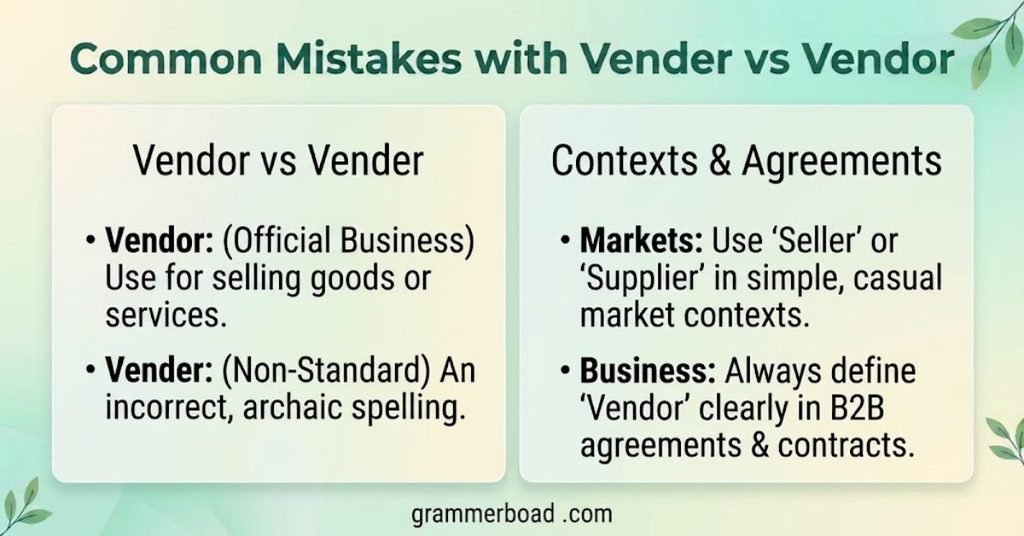
Writers often make a few predictable errors with this word:
- Assuming “vender” is the British spelling. It is not. Both varieties of English prefer “vendor.”
- Mixing spellings in the same document. Pick one form and stay consistent. Choose “vendor.”
- Confusing “vendor” with “vendee.” A vendor sells, while a vendee is the person who buys, a term mostly used in legal contexts.
- Misspelling it as “vendar.” This spelling is simply incorrect.
- Relying on the “-er” pattern. Because “seller” ends in “-er,” some writers assume “vender” must be correct. But English spelling does not always follow that pattern, especially for words with Latin roots.
- One of the most common Vender vs Vendor mistakes is assuming that both forms are equally popular. In modern writing, vendor is the standard form you should remember.
Understanding Vender vs Vendor helps writers avoid spelling errors when discussing sellers, suppliers, and businesses. Remember that vendor is the preferred spelling in both British and American English.
Is Vender a Correct English Word?
“Vender” is not entirely wrong, but it is not a good choice for most writing. Some dictionaries list it as a variant spelling of “vendor,” while others do not give it much attention. Even where it is recorded, it is described as less common.
In short, it exists, but it is uncommon enough that using it may make your writing look careless. Unless a particular style guide or older document requires it, choose “vendor.”
vendor vs vender in Everyday Examples
Here are a few simple sentences that show the standard spelling in natural use:
- The vendor at the corner stall sells fresh fruit every morning.
- We are changing our software vendor next quarter.
- Each vendor must submit an invoice before payment is processed.
- The festival invited more than fifty food vendors this year.
- I called the vendor to ask about the delayed shipment.
Notice how “vendor” fits both casual and professional sentences without sounding stiff.
Examples of Vendor in Business Sentences
In business settings, the word appears often in documents and day-to-day communication. Here are some realistic examples:
- Our procurement team reviews every new vendor before signing a contract.
- The vendor agreed to deliver the equipment within ten working days.
- Please send the vendor details to the accounts department.
- A reliable vendor can make a big difference in supply chain performance.
- The company keeps a list of approved vendors for office supplies.
- We negotiated better payment terms with our main vendor.
Vender Meaning
When “vender” is used, it carries the same meaning as “vendor”: a person or business that sells something. It is not a different word with a separate definition, only an alternate spelling.
You may come across it in older writing or in certain regional or specialized texts. If you see it, you can read it as “vendor.” When writing something new, however, the standard spelling is the better choice.
What Does Vendor Mean in Business?
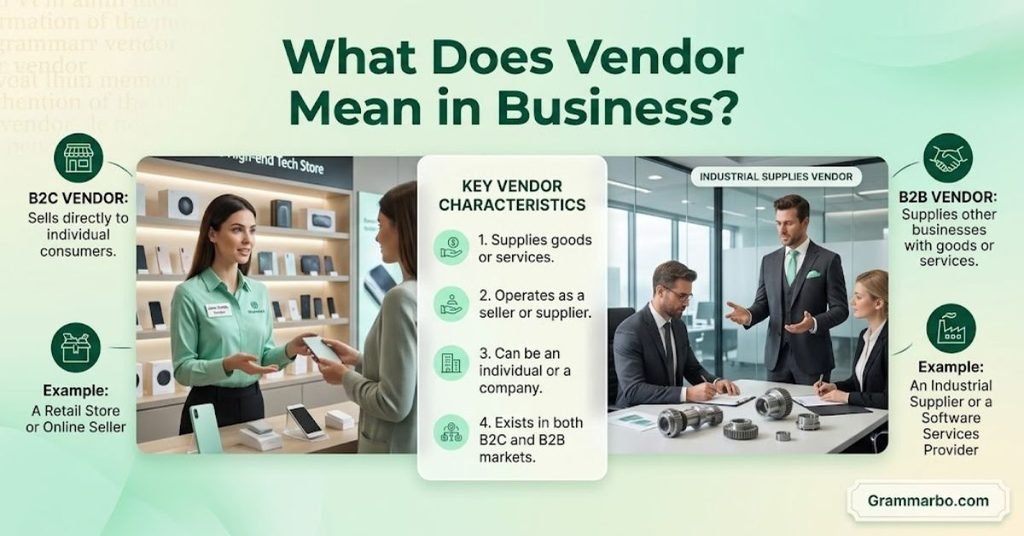
In business, a vendor is any individual or organization that supplies goods or services in exchange for payment. The term is broad and can describe:
- A manufacturer that sells products to a retailer
- A service provider, such as a cleaning or IT company
- A software company that licenses its product to customers
- A small seller at a market, fair, or event
Businesses often manage many vendors at once, which is why topics like vendor selection, vendor contracts, and vendor performance are common in operations and finance.
Synonyms for Vendor and Their Meanings
Depending on the context, you may prefer a different word. Here are common alternatives:
| Synonym | Meaning |
| Seller | A general term for anyone who sells something |
| Supplier | A business that provides goods or materials, often in bulk |
| Merchant | A person or company that trades in goods |
| Retailer | A business that sells directly to consumers |
| Dealer | A person or business that buys and sells specific goods |
| Trader | Someone who buys and sells goods or commodities |
| Provider | A person or company that supplies a service |
| Peddler | A person who sells goods, often on the street or door to door |
Choose the synonym that best fits the situation. “Supplier” suits business-to-business trade, while “seller” works well in casual conversation.
Comparison Table: Vender vs Vendor
| Feature | Vendor | Vender |
| Meaning | A person or business that sells | The same meaning |
| Standard spelling | Yes | No, uncommon variant |
| American English | Preferred | Rarely used |
| British English | Preferred | Rarely used |
| Business and legal writing | Standard choice | Not recommended |
| Spellcheck acceptance | Usually accepted | May be flagged |
| Best choice for modern writing | Yes | No |
Why Is Vendor More Common Than Vender?
Several factors explain why “vendor” became the dominant form.
First, its Latin-style ending matches many other formal and professional terms, which made it feel more natural in business and legal contexts.
Second, consistent use in commerce strengthened it. As trade, contracts, and record keeping became more standardized, writers settled on one spelling, and “vendor” became the norm.
Third, modern tools reinforce it. Dictionaries, style guides, and spellcheck software all favor “vendor,” so writers see it far more often than the alternative.
The more a spelling is used, the more people expect it, and that cycle keeps “vendor” firmly in place.
If you are still unsure about Vender vs Vendor, remember that vendor is the preferred spelling for modern English. Use it whenever you refer to a person or business selling goods or services.
Also Read This:https://grammarboad.com/tongue-emoji/
FAQs
Is it vender or vendor?
The correct and standard spelling is vendor. “Vender” is a rare variant that most writers should avoid.
Is vender a real word?
It appears in some references as an alternate spelling, but it is far less common and not recommended for modern writing.
Is vendor British or American spelling?
Neither. “Vendor” is the standard spelling in both British and American English.
What is the difference between a vendor and a supplier?
The terms often overlap. A vendor is anyone who sells goods or services, while a supplier usually refers to a business that provides materials or products, often in larger quantities, to another business.
Can I use vender in business writing?
It is best not to. Readers may see it as a typo, and “vendor” is the accepted form in contracts, invoices, and professional communication.
What is the plural of vendor?
The plural is vendors.
Conclusion
When choosing between “vender or vendor,” the answer is simple: use vendor. It is the standard spelling in both American and British English, it is the form readers expect, and it works in every context from street markets to corporate contracts.The Vender vs Vendor spelling difference may seem small, but choosing the correct form makes your business communication more professional and easier to understand.
The Vender vs Vendor spelling difference may seem small, but choosing the correct form makes your business communication more professional and easier to understand.
“Vender” may appear in older or specialized writing, but it has no real advantage today. If you remember the “-or” pattern shared with words like “investor” and “creditor,” and default to “vendor” whenever you are unsure, you will avoid the mistake every time.