
Vicious vs Viscous are two commonly confused words that look alike but have completely different meanings. Vicious describes cruelty, violence, or harmful behavior, while viscous describes a thick liquid that flows slowly. Understanding the difference between vicious vs viscous can help you avoid spelling mistakes and use both words correctly in everyday writing.
This guide explains the meaning, origin, pronunciation, and usage of vicious vs viscous, along with five simple tips to help you remember the difference and use each word correctly.
Vicious or Viscous – Quick Answer
Vicious means cruel, violent, or intended to cause harm. Viscous means thick and sticky, describing a liquid that resists flowing easily.
- A vicious attack, rumor, or animal is aggressive or malicious.
- A viscous substance, such as honey, motor oil, or molasses, moves slowly.
If you are describing behavior, intent, or danger, use vicious. If you are describing the texture or flow of a liquid, use viscous.
What Does Vicious Mean?

Vicious is an adjective describing something or someone that is deliberately cruel, savage, or harmful. It can refer to physical violence, but it is just as often used for harsh words and bitter behavior.
Common meanings include:
- Violent or dangerous: a vicious storm, a vicious attack
- Spiteful or malicious: a vicious rumor, a vicious remark
- Severe or intense: a vicious cold, a vicious cycle
- Prone to bad behavior: a vicious animal
The word often appears in the phrase vicious circle (or vicious cycle), which describes a situation where one problem leads to another that makes the first one worse.
What Does Viscous Mean?

Viscous is an adjective used in science, cooking, and everyday description for liquids that are thick, sticky, and slow to pour. The scientific term for this property is viscosity.
Examples of viscous substances include:
- Honey
- Molasses
- Engine oil
- Glue
- Lava
- Thick paint
Water has low viscosity, so it flows easily. Honey has high viscosity, so it moves slowly. The word is neutral and descriptive; it carries no emotional or moral meaning at all.
The Origin of Vicious or Viscous
Both words trace back to Latin, which helps explain why they look so similar even though their meanings have drifted far apart.
Vicious comes from the Latin vitiosus, meaning faulty or full of vice, which is related to vitium (a fault or defect). Over time, the sense moved from “flawed” to “morally bad” and eventually to “cruel and violent.”
Viscous comes from the Latin viscosus, meaning sticky, which is related to viscum, the Latin word for mistletoe. Sticky mistletoe berries were historically used to make a glue-like substance called birdlime, which explains the connection to stickiness.
So the two words come from different Latin roots: one about faults and vice, the other about stickiness.
Vicious vs Viscous: Pronunciation Differences
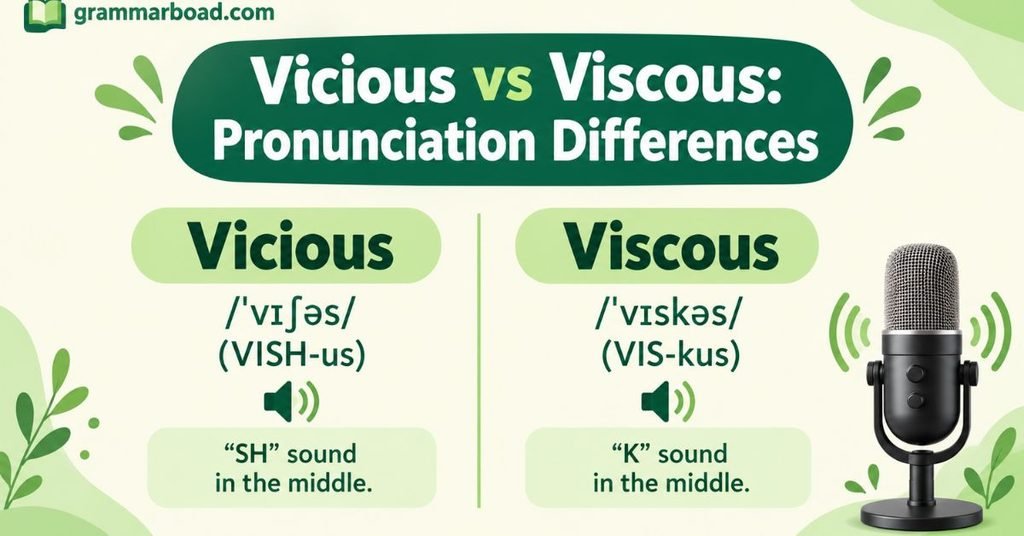
The pronunciations are close but not identical.
| Word | Phonetic Spelling | Sounds Like |
| Vicious | VISH-us | The “sh” sound in the middle |
| Viscous | VIS-kus | A hard “sk” sound in the middle |
The difference is in the middle consonants. Vicious has a soft “sh,” while viscous has a crisp “sk.” Listening for that “k” sound is a helpful cue when you hear either word in conversation.
British English vs American English Spelling
Unlike many commonly confused word pairs, there is no spelling difference between British and American English here. Both varieties use vicious and viscous in exactly the same way.
The only related spelling variation worth noting is in compound or derived forms, and even those are consistent across regions: viciousness, viscosity, and viscously are spelled the same in the UK, the US, Canada, and Australia.
Which Spelling Should You Use?
This is not a matter of choosing a preferred spelling. The two words are not variants of each other, so the correct choice depends entirely on meaning.
Ask yourself one question: Am I describing cruelty or thickness?
- Cruelty, aggression, harm, or severity → vicious
- Thickness, stickiness, or slow flow → viscous
No situation exists where one can stand in for the other.
Vicious vs Viscous: Parts of Speech and Grammar
Both words are adjectives, so they modify nouns and can appear before a noun or after a linking verb.
- The vicious dog barked at the gate. (before the noun)
- The syrup was viscous. (after a linking verb)
Each word has related forms:
| Base Word | Noun | Adverb |
| Vicious | Viciousness | Viciously |
| Viscous | Viscosity | Viscously |
Note that the noun form of viscous is viscosity, not “viscousness.” The noun for vicious is viciousness. Mixing these up is a common slip.
Common Mistakes with Vicious or Viscous
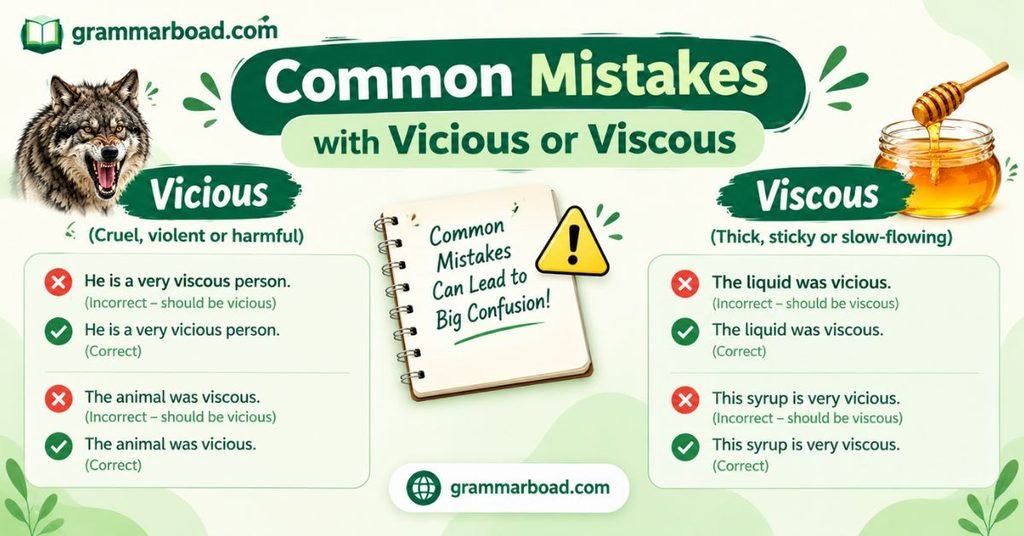
Swapping the words in speech. Because they sound alike, people sometimes say one when they mean the other, especially when speaking quickly.
Relying on spell-check. Both words are real, so spell-check will not flag the wrong one. A sentence like “The oil was vicious” is spelled correctly but makes no sense.
Using “viscious.” This spelling is incorrect. The correct word is vicious, with no “s” before the “c” in the middle.
Spelling the noun incorrectly. The noun for thickness is viscosity, and the noun for cruelty is viciousness. Writers sometimes blend the two.
Using “viscous” for a harsh personality. Calling a mean person “viscous” would suggest they are thick and sticky, which is almost certainly not the intended meaning.
Vicious or Viscous in Everyday Examples
You are most likely to meet vicious in news, conversation, and storytelling: a vicious storm hitting a coastline, a vicious argument between coworkers, or a vicious online comment.
You are most likely to meet viscous in cooking, science, mechanics, and manufacturing: a viscous sauce, viscous engine oil that needs changing, or viscous lava creeping down a slope.
Context is usually the biggest clue. If the subject is a person, animal, or event, vicious is almost always right. If the subject is a liquid or gel, viscous is almost always right.
10 Example Sentences Using Vicious and Viscous
Vicious
- The critic wrote a vicious review that left the author stunned.
- A vicious wind tore the umbrella from her hand.
- Rumors can be vicious, especially when no one checks the facts.
- The team was caught in a vicious cycle of late deliveries and unhappy customers.
- The guard dog had a reputation for being vicious toward strangers.
Viscous
- The honey was so viscous that it barely dripped from the spoon.
- Cold weather makes motor oil more viscous and harder to circulate.
- She stirred the viscous batter until it was smooth.
- Viscous lava moved slowly down the volcano’s slope.
- The chemist measured how viscous the new solution was at different temperatures.
Synonyms and Antonyms of Vicious and Viscous
Vicious
- Synonyms: cruel, brutal, savage, malicious, spiteful, ferocious, violent
- Antonyms: gentle, kind, mild, harmless, peaceful, compassionate
Viscous
- Synonyms: thick, sticky, gooey, syrupy, gluey, tacky, gummy
- Antonyms: thin, runny, watery, fluid, free-flowing
Keep in mind that synonyms are never perfect replacements. “Savage” and “vicious” overlap but differ in tone, and “syrupy” and “viscous” can differ in how formal they sound.
How to Remember the Difference Between Vicious and Viscous
Here are five easy ways to avoid mistakes when using Vicious vs Viscous.
1. Link “vicious” to “vice.” Both begin with vic. A vice is a bad habit or wrongdoing, and vicious behavior is cruel or harmful behavior.
2. Link “viscous” to “viscosity.” If you picture the word viscosity in a science class or on an oil bottle, you will remember that viscous describes thickness.
3. Listen for the sound. Vicious has a “sh” sound. Viscous has a hard “k” sound, like the “sk” in “sky” or “skid.”
4. Notice the “s-c” in viscous. The letters s and c appear together in viscous and viscosity, creating a crisp “sk” sound. Vicious does not have this letter combination.
5. Ask what the word describes. If it describes a person, an action, or behavior, choose vicious. If it describes a thick liquid, choose viscous. These five tips make the difference between Vicious vs Viscous easier to remember and help you avoid common writing mistakes.
Vicious vs Viscous: Real-Life Situations and Context
In the kitchen. A recipe might ask you to simmer a sauce until it is viscous, meaning thick enough to coat the back of a spoon. You would never describe the sauce as vicious unless it somehow attacked you.
In the garage. Mechanics talk about the viscosity of engine oil, and cold weather can make oil more viscous. A mechanic would never call the oil vicious.
In the news. Reports of a vicious assault, a vicious storm, or a vicious political attack all describe harm or severity.
In science class. Students learn that some fluids are more viscous than others, such as comparing water, olive oil, and honey.
In writing and fiction. An author might describe a vicious villain and a viscous swamp in the same scene. Both words are useful, and they never overlap in meaning.
Vicious or Viscous – Google Trends & Usage Data

Search interest in these two words tends to follow a simple pattern: people look up vicious in connection with news events, entertainment titles, and everyday language, while searches for viscous are often tied to science, cooking, and engineering topics.
Because search trends change over time and vary by region, readers who want current numbers can check Google Trends directly by entering both words in the comparison tool. This is a useful way to see how interest differs by country, season, or time period.
Generally, vicious is the more familiar word in everyday speech, while viscous is more specialized, which is part of why the two get confused when someone meets the rarer one.
Comparison Table: Vicious vs Viscous
| Feature | Vicious | Viscous |
| Part of speech | Adjective | Adjective |
| Core meaning | Cruel, violent, or harmful | Thick, sticky, slow-flowing |
| Describes | People, animals, actions, words, events | Liquids, gels, semi-fluids |
| Pronunciation | VISH-us | VIS-kus |
| Noun form | Viciousness | Viscosity |
| Adverb form | Viciously | Viscously |
| Origin | Latin vitiosus (faulty, full of vice) | Latin viscosus (sticky) |
| Example | A vicious attack | Viscous honey |
| Tone | Negative, emotional | Neutral, descriptive |
Vicious vs Viscous: Frequently Confused Words
If these two trip you up, a few other pairs deserve attention:
- Viscid vs viscous: Both relate to stickiness. Viscid is a less common word, often used in biology and botany.
- Vicious vs viscious: “Viscious” is a misspelling, and the correct word is vicious.
- Viscosity vs velocity: Viscosity is about resistance to flow, while velocity is speed in a given direction.
- Malicious vs vicious: Malicious stresses intent to harm, while vicious can also describe something severe or fierce, like a storm.
- Vice vs vise: A vice is a bad habit, while a vise is a tool that clamps objects (spelled vice in British English).
Also Read This:https://grammarboad.com/of-course-or-ofcourse/
FAQs
Is it vicious or viscous?
Both are correct words, but they mean different things. Use vicious for cruelty or violence and viscous for thick, sticky liquids.
Can a person be viscous?
Not in the literal sense. A person can be vicious if they are cruel, but calling someone viscous would imply they are thick and sticky like syrup.
Can a liquid be vicious?
Only figuratively. A raging flood or a violent wave might be called vicious, but a thick liquid like honey would be viscous.
Is “viscious” ever correct?
No. “Viscious” is a common misspelling. The correct spelling is vicious.
What is the noun form of viscous?
The noun is viscosity, meaning the thickness or resistance to flow of a fluid.
What is the noun form of vicious?
The noun is viciousness.
Do British and American English spell these words differently?
No. Both varieties use the same spellings for both words.
What is a quick trick to tell them apart?
Connect vicious with vice and viscous with viscosity.
Conclusion
Vicious vs Viscous can be confusing because these words look and sound similar, but they have different meanings. Vicious describes cruel, aggressive, or harmful behavior, while viscous describes thick liquids that flow slowly, such as honey or syrup. Understanding the difference between vicious vs viscous will help you choose the correct word in your writing.
For the definition and usage of vicious, visit the Merriam-Webster dictionary. Remember this simple rule: use vicious for harmful behavior and viscous for a liquid’s thickness. With these examples and tips, you can avoid common vicious vs viscous mistakes and improve your writing accuracy.