If you have ever typed “fulltime” and wondered whether a red squiggly line was about to embarrass you, you are not alone. The question of full time or fulltime trips up students, job seekers, and professional writers alike, mostly because the phrase looks like it should be one word.
The short version: standard English does not treat “fulltime” as a correct spelling. The correct forms are full time (as a noun or adverb) and full-time (as an adjective before a noun). This guide walks through the rules, the reasoning behind them, and plenty of examples so you can get it right every time.
Fulltime – Quick Answer
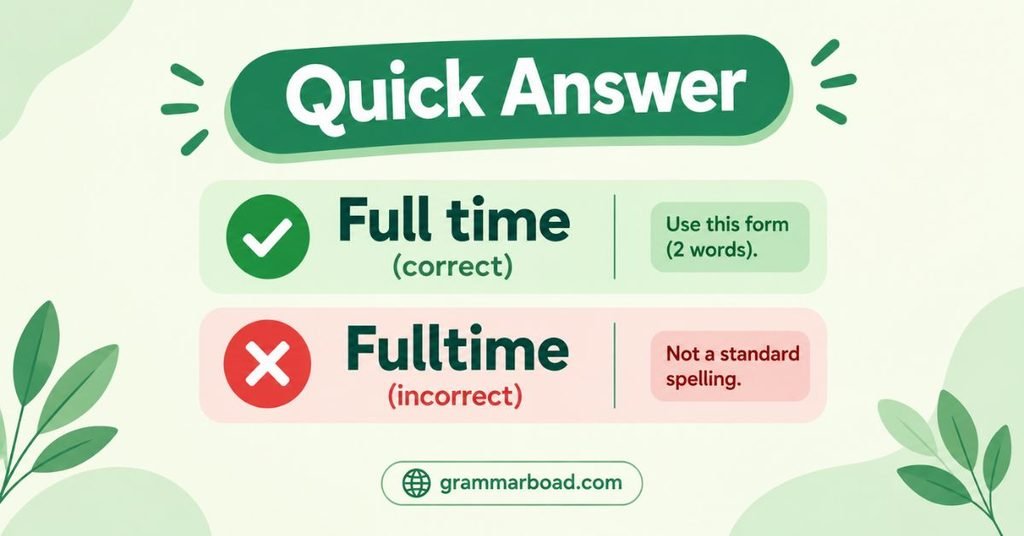
“Fulltime” written as one word is considered incorrect in standard written English. Major dictionaries list “full-time” (hyphenated) and “full time” (two words), and neither recognizes the closed compound as standard.
Here are the five simple rules at a glance:
- Never write “fulltime” as one word in formal or professional writing.
- Use “full-time” with a hyphen when it describes a noun: a full-time job.
- Use “full time” without a hyphen when it follows the verb as an adverb:She works on a regular 40-hour schedule (full time).
- Use “full time” as a noun when referring to the end of a match or a standard work schedule: The referee blew the whistle at full time.
- Stay consistent with whichever style your publication or employer follows.
What Does Full Time Mean?
“Full time” refers to the complete or standard amount of time devoted to something. Most often it describes employment, where it means working the standard number of hours set by an employer or by law. That number varies by country, company, and industry, so there is no single universal definition.
The phrase also appears in other settings:
- Education: a student enrolled in a full course load.
- Sports: the end of a match, as in “the score at full time.”
- Everyday speech: doing something as your main commitment, such as parenting or caregiving.
In every case, the core idea is the same: complete, undivided, or standard time rather than a reduced portion of it.
The Origin of Full Time or Fulltime
The phrase is a straightforward combination of two long-established English words: “full” and “time.” Over the years, English has joined many such pairs into hyphenated compounds, especially when they act as modifiers. “Full-time” followed that pattern as employment terms became more common in everyday language.
You will occasionally see “fulltime” in informal writing, job boards, social media posts, and even some brand names. This usually comes from the natural tendency of English compounds to shorten over time, the same way “e-mail” became “email.” So far, though, “fulltime” has not gained acceptance in standard dictionaries or style guides, so it remains best avoided in careful writing.
British English vs American English Spelling
Good news: there is no real split here. Both British and American English use the same forms, full time and full-time, following the same rules. The difference lies elsewhere.
One small distinction is worth knowing. In British English, “full time” is commonly used as a noun in football (soccer) to mean the end of a match. American English more often uses “final whistle” or “the end of the game” for the same idea. The spelling rules themselves do not change between the two varieties.
Which Spelling Should You Use?
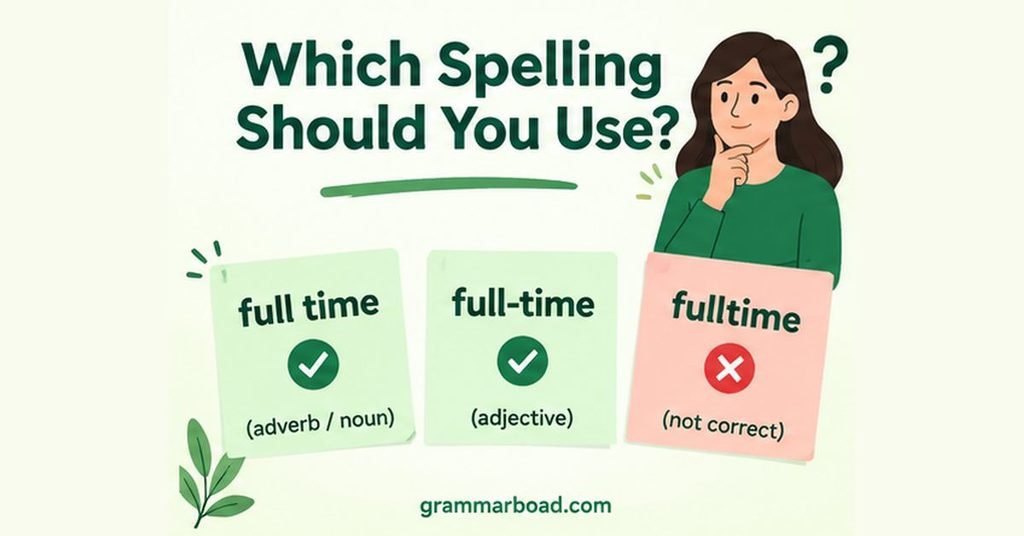
Choose based on how the phrase functions in your sentence:
| Situation | Correct Form | Example |
| Describes a noun (before it) | full-time | She accepted a full-time position. |
| Follows a verb (adverb) | full time | He works full time. |
| Used as a noun | full time | Full time is 40 hours at this company. |
| One-word version | fulltime | Not standard; avoid. |
If you are unsure, ask yourself one question: Is it sitting directly in front of a noun? If yes, hyphenate it.
Common Mistakes with Full Time or Fulltime
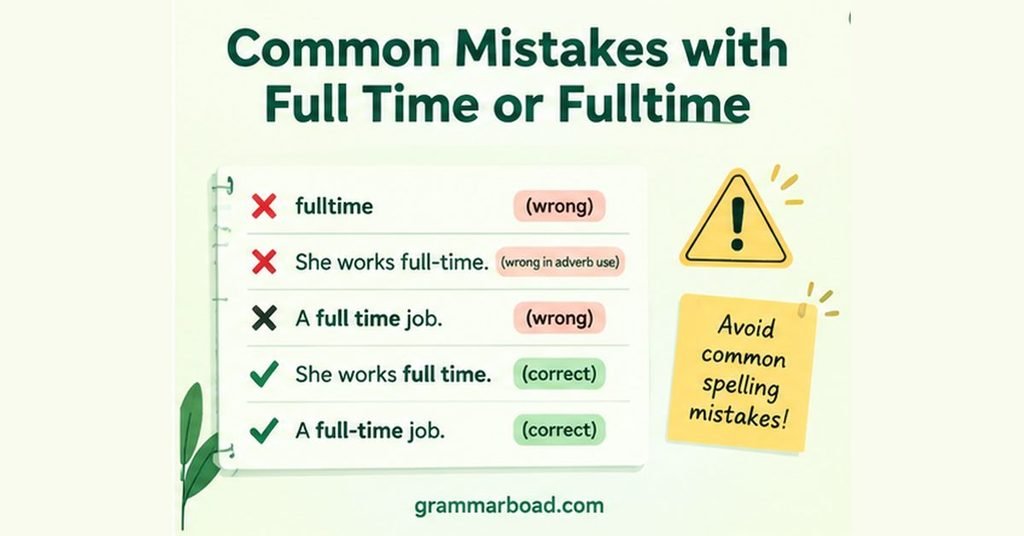
A few errors show up again and again:
- Writing “fulltime” as one word. This is the most frequent mistake, and spell-checkers often flag it.
- Hyphenating the adverb. “She works on a regular 40-hour schedule (full time).” is common in everyday writing, and many people use it, but strict style guides preferShe works full time.” when the phrase comes after the verb.
- Dropping the hyphen before a noun. ” job” is widely seen, but “a full-time job” is the more polished choice.
- Mixing styles in one document. Using “full-time” in one paragraph and “full time” in another for the same function looks inconsistent.
Note that some dictionaries and style guides accept the hyphenated form in both positions, so the adverb case is the area where practice varies most. When in doubt, follow the style guide your publication uses.
How to Remember the Correct Spelling
Here are a few simple memory tricks:
- The glue rule: The hyphen works like glue, joining “full” and “time” into a single describing word. If the phrase is describing a noun, add the glue.
- The “works” test: If the phrase comes after a verb like works, studies, or teaches, leave it as two words.
- The one-word warning: If you feel tempted to squash it into “fulltime,” remember that no standard dictionary does this for you.
Full Time or Fulltime in Everyday Examples
Real-life usage makes the rules easier to absorb:
- A job listing: “We are hiring a full-time receptionist.”
- A casual conversation: “I just started working full time.”
- A school form: “Are you enrolled as a full-time student?”
- A sports commentary: “The score was 2–1 at full time.”
Notice how the hyphen appears only when the phrase sits right before the noun it describes.
10 Example Sentences Using Full Time and Full-Time
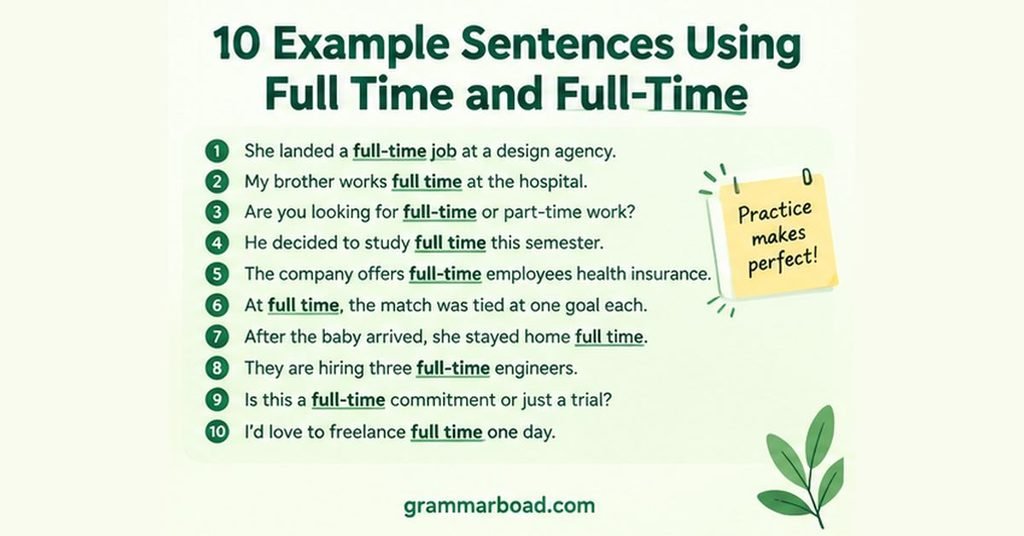
- She landed a full-time job at a design agency.
- My brother works full time at the hospital.
- Are you looking for full-time or part-time work?
- He decided to study full time this semester.
- The company offers full-time employees health insurance.
- At full time, the match was tied at one goal each.
- After the baby arrived, she stayed home full time.
- They are hiring three full-time engineers.
- Is this a full-time commitment or just a trial?
- I’d love to freelance full time one day.
Is “Full Time” Hyphenated?
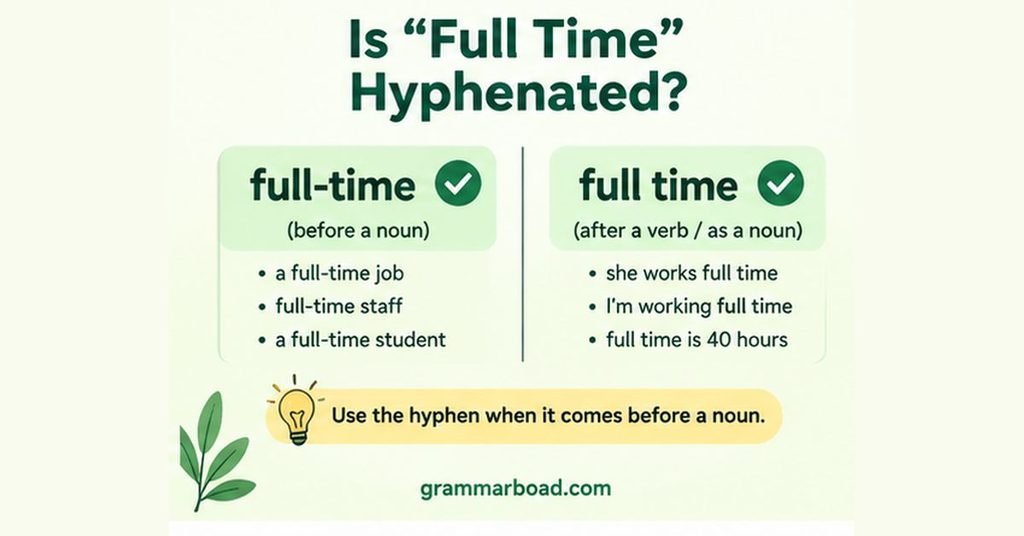
It depends on its role in the sentence.
- Hyphenated: when it works as an adjective placed before a noun (a full-time job, full-time staff).
- Not hyphenated: when it works as an adverb after a verb (She works on a regular 40-hour schedule (full time).) or as a noun (full time was called).
This follows a general English pattern for compound modifiers: hyphens help the reader see that two words function together as one idea, but they are usually unnecessary when the phrase appears after the word it relates to. Keep in mind that some dictionaries list “full-time” as acceptable in both adjective and adverb positions, so you may see both used.
Full Time as an Adjective vs an Adverb
Understanding the grammar makes the rule feel natural.
As an adjective (modifying a noun):
- She has a full-time schedule.
- He is a full-time teacher.
As an adverb (modifying a verb):
- She teaches full time.
- They volunteer full time during the summer.
As a noun:
- Full time is usually defined by the employer.
- The whistle blew at full time.
A quick way to check: if you can swap the phrase with a single-word adjective like “permanent” or “regular” before a noun, you are using it as an adjective and should hyphenate.
Full-Time Meaning in Job
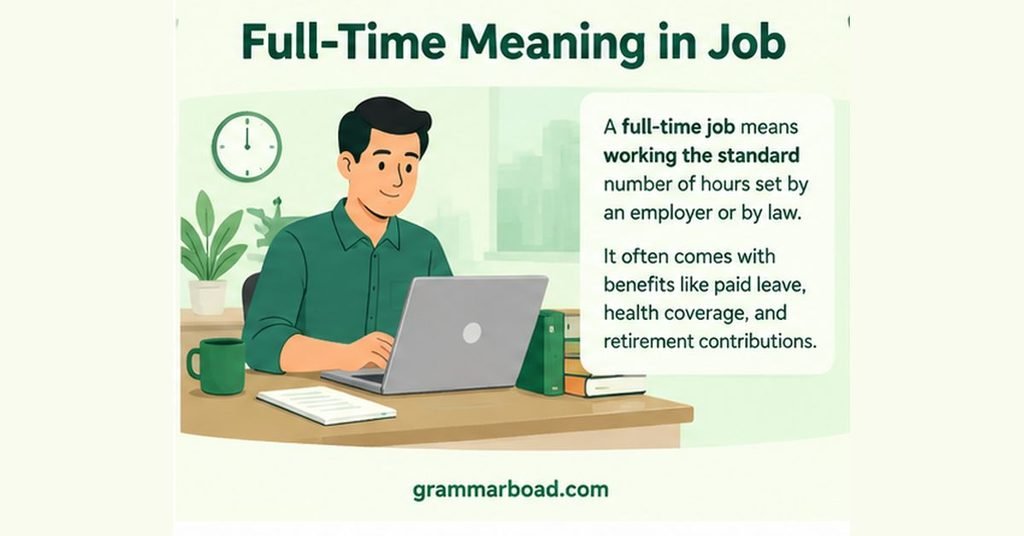
In the workplace, full-time describes an employee who works the standard or expected hours for a role. The exact threshold differs by country, employer, and local labor law, so the number of weekly hours is not the same everywhere.
Full-time roles commonly (though not always) come with benefits such as paid leave, health coverage, or retirement contributions. These vary widely between employers and regions, so it is always wise to check a job offer or employment contract for specifics.
Full-Time Jobs vs Part-Time Jobs
The main difference is the number of hours worked, though other differences often follow.
| Feature | Full-Time | Part-Time |
| Weekly hours | Standard or higher hours set by the employer | Fewer than full-time hours |
| Schedule | Usually more predictable | Often more flexible |
| Benefits | Commonly more extensive (varies) | Often more limited (varies) |
| Income | Generally higher overall | Generally lower overall |
| Best for | Career-building, stable income | Students, caregivers, side income |
Neither is better in every case. The right choice depends on your financial needs, goals, and lifestyle.
Full-Time or Full-Time Student?
Despite the heading’s odd phrasing, the useful question here is how to write “full-time student” correctly. Since “full-time” sits directly before the noun “student,” it takes a hyphen: a full-time student.
A full-time student is generally someone enrolled in the minimum number of credits or courses their institution defines as a full load. That threshold depends on the school and country. If you say, “She studies full time,” the hyphen disappears because the phrase now follows the verb.
Full-Time Synonyms and Related Terms
If you want variety in your writing, these alternatives can work depending on context:
- Permanent (in some contexts, though it refers to contract length rather than hours)
- Regular
- Standard-hours
- Round-the-clock (informal, for constant activity)
- Dedicated (when describing commitment)
Related terms worth knowing:
- Part-time: fewer hours than full-time.
- Casual: irregular or as-needed work.
- Contract: work for a fixed term or project.
- Freelance: self-employed, project-based work.
Keep in mind that these are not perfect substitutes. “Permanent,” for example, describes job security more than weekly hours.
Full Time or Full-Time?
This is the real heart of the matter, and the answer is simple:
- Use full-time (hyphenated) before a noun: a full-time role.
- Use full time (two words) after a verb or as a noun: working full time.
Both are correct in their proper places. The only version to avoid is “fulltime,” which reads as an error in most formal contexts.
Full Time or Fulltime in Formal and Professional Writing
In résumés, cover letters, business emails, academic papers, and published articles, accuracy signals attention to detail. Writing “fulltime” can make an otherwise strong document look careless.
A few professional tips:
- On résumés: write “Full-time” when it appears as a label before a job type, such as “Full-time Marketing Manager.”
- In emails: follow the standard rule and keep it consistent.
- In published work: check your house style guide, since some publications set specific hyphenation preferences.
When you are not sure, the hyphenated “full-time” is rarely wrong in a modifier position and is the safest choice.
Also Read This:https://grammarboad.com/tongue-emoji/
Full Time or Fulltime – Google Trends & Usage Data
Search interest in questions like “full time or fulltime” shows that many people are unsure about the correct form. Because search trends change over time and vary by region, readers who want precise numbers can check Google Trends directly by comparing “full time,” “full-time,” and “fulltime.”
What you will generally notice when exploring such data is that the one-word spelling appears in searches and informal usage, yet standard dictionaries and style guides continue to recommend the two-word and hyphenated forms. Popularity in casual use does not make a spelling standard.
Full Time vs Full-Time vs Fulltime Comparison Table
| Form | Part of Speech | Standard? | Example |
| Full time | Adverb / Noun | Yes | She works on a regular 40-hour schedule (full time). |
| Full-time | Adjective | Yes | He has a full-time job. |
| Fulltime | Not recognized | No | Avoid in formal writing. |
Frequently Asked Questions
Is “fulltime” a real word?
It appears in informal writing, but it is not recognized as standard in major dictionaries. Use “full-time” or “full time” instead.
Should I hyphenate “full-time” on my résumé?
Yes, when it comes directly before a noun, such as “full-time position.”
Is it “work full time” or “work full-time”?
Both appear in print. Strict style guides prefer “work full time,” while some dictionaries also accept the hyphenated form. Be consistent either way.
What is the opposite of full-time?
Part-time is the most common opposite.
Does full-time have the same meaning in every country?
No. The number of hours that counts as full-time depends on the employer and local regulations.
Can I use “full time” as a noun?
Yes. For example, “The score at full time was 3–2.”
Conclusion
The full time or fulltime debate has a clear answer. Skip the one-word “fulltime” and choose between two correct forms: full-time before a noun and full time after a verb or as a noun. Remember the glue rule, run the “works” test, and stay consistent across your writing.
With these five simple rules, you can write confidently on résumés, in emails, and in any professional document, knowing your spelling is accurate and polished.