Have you ever paused while writing a greeting and wondered whether it should be “good morning” or “goodmorning”? You are not alone. Both spellings look similar, and the one-word version often appears in text messages and on social media. However, only good morning is correct in standard English. Understanding the correct good morning spelling can help you write greetings confidently.
The difference between good morning vs. goodmorning is simple once you understand how the phrase works. “Good morning” is written as two separate words, while “goodmorning” is a common spelling mistake. This guide explains the correct spelling, its meaning, grammar rules, and how to use it in emails, messages, and formal writing.
Good Morning vs. Goodmorning: The Quick Answer
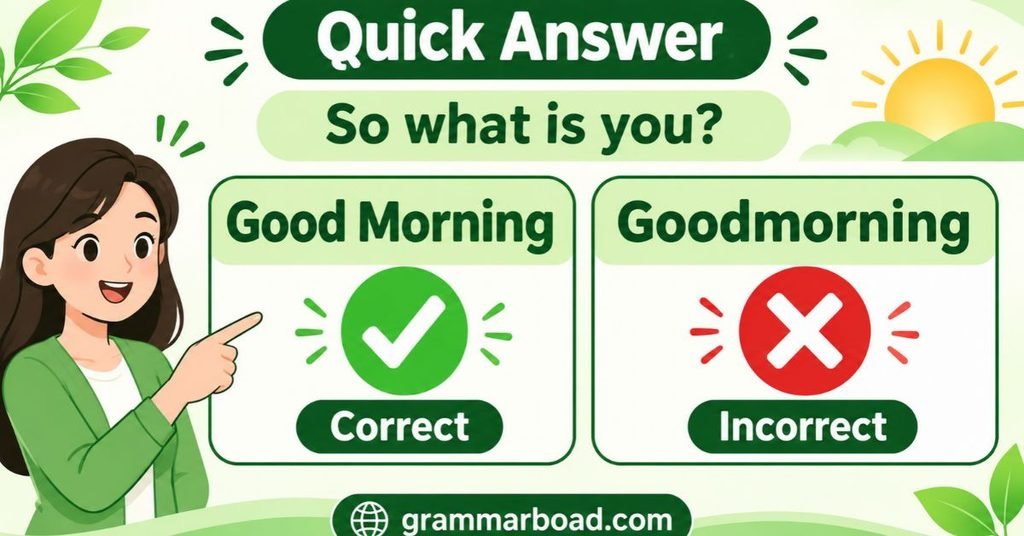
“Good morning” is correct. “Goodmorning” is incorrect in standard English.
“Good morning” consists of two separate words: the adjective good and the noun morning. Standard English dictionaries recognize the two-word expression, not the joined spelling “goodmorning.”
For example:
- Correct: Good morning! How are you?
- Incorrect: Goodmorning! How are you?
Always write “good morning” as two words in regular English sentences.
Why Is “Good Morning” Two Words?
“Good morning” is a phrase made up of two words that retain their individual meanings. The word good describes something positive, while morning refers to the early part of the day.
Together, they form a friendly greeting used when meeting someone in the morning.
English has several similar greetings, including:
- Good afternoon
- Good evening
- Good night
These expressions are also written as separate words. Following the same pattern makes your writing consistent and grammatically correct.
Is “Goodmorning” a Word?
No. “Goodmorning” is not an accepted standard English spelling. It is generally considered a spelling mistake because the correct expression consists of two separate words.
You may occasionally see it used as a brand name, username, or hashtag. However, these are creative or online uses rather than standard English spelling.
For everyday communication, always choose “good morning.”
What Does “Good Morning” Mean?
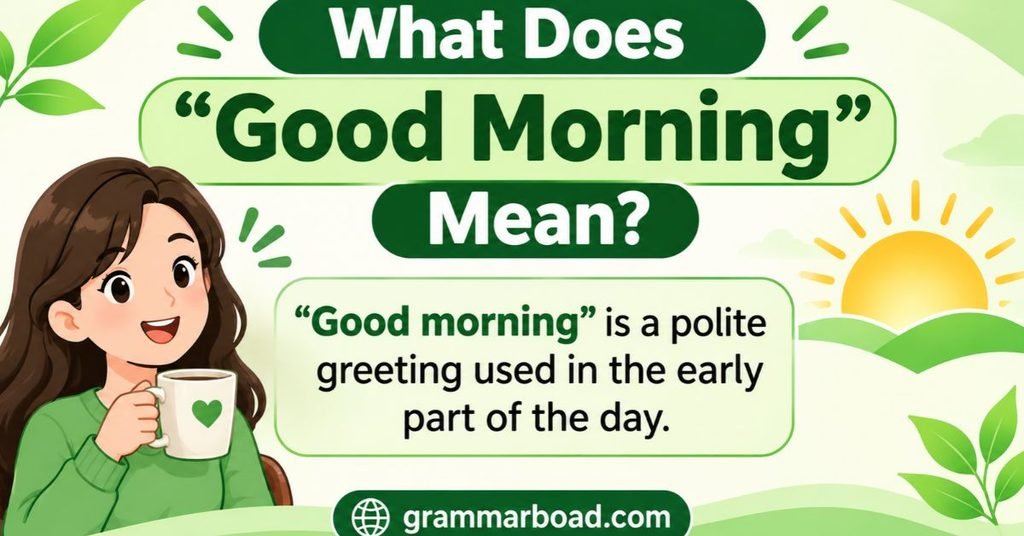
“Good morning” is a polite and friendly greeting used during the early part of the day. It expresses kindness, respect, and good wishes toward the person you are addressing.
The expression can also be understood as a shortened version of a wish for someone to have a pleasant morning.
For example:
- Good morning! I hope you have a wonderful day.
- Good morning, everyone. Welcome to the meeting.
It is a simple expression that helps people begin conversations on a positive note.
Is “Good Morning” a Greeting?
Yes. “Good morning” is one of the most common greetings in English. People use it when meeting someone, starting a conversation, making a phone call, or sending a morning message.
It is also commonly used to open:
- Business meetings
- School presentations
- Public speeches
- Television and radio broadcasts
- Professional emails
Because it works in both casual and formal situations, “good morning” is a useful greeting for almost any setting.
Should “Good Morning” Be Capitalized?
Capitalization depends on where the expression appears in a sentence or message.
Here are the basic rules:
- At the beginning of a sentence: Capitalize the first word. Example: Good morning! I hope you are doing well.
- In the middle of a sentence: Use lowercase. Example: She smiled and said good morning to her neighbors.
- At the beginning of an email: Capitalize the first word. Example: Good morning, Sarah,
- In a title: Follow the capitalization style used for the title.
Remember that both words do not need capital letters in ordinary sentences. “Good morning” is generally the standard form, not “Good Morning.”
Good Morning vs. Goodmorning: Grammar Difference
The grammar difference between these two forms is straightforward.
| Form | Status | Explanation |
| Good morning | Correct | Two separate words: adjective + noun |
| Goodmorning | Incorrect | Not a standard English compound word |
In the expression “good morning,” the word good describes the noun morning. Both words have their own grammatical roles.
Joining them without a space changes the spelling into a nonstandard form. Therefore, “good morning” is the correct choice in standard English.
Good Morning vs. Goodmorning: Examples of Correct Usage
The easiest way to understand the correct spelling is to see how it works in everyday communication.
Here are some examples:
- Good morning, class. Please open your books.
- The shopkeeper smiled and said good morning.
- Good morning, everyone. Let’s get started.
- I always wish my family a good morning.
- She greeted her colleagues with a cheerful good morning.
In every example, the expression remains two separate words, whether it appears at the beginning or in the middle of a sentence.
Examples of “Good Morning” in Sentences
Here are five additional examples showing how to use “good morning” naturally:
- Good morning! Did you receive my message last night?
- I always say good morning to my neighbors during my morning walk.
- The television host opened the show with a cheerful “Good morning.”
- She whispered good morning so she would not wake the baby.
- Good morning, Mr. Khan. Your appointment is at ten.
These examples show that the correct spelling remains the same in different situations.
Incorrect Examples With “Goodmorning”
Writing “goodmorning” as one word is a common mistake, especially in quick messages and online conversations.
Here are some incorrect examples:
- Incorrect: Goodmorning, team!
- Incorrect: I said goodmorning to my teacher.
- Incorrect: Goodmorning! How are you today?
The correct versions are:
- Correct: Good morning, team!
- Correct: I said good morning to my teacher.
- Correct: Good morning! How are you today?
The simple solution is to insert a space between “good” and “morning.”
Common Punctuation With “Good Morning”
Correct punctuation makes your greeting easier to read and more professional.
Here are three common punctuation choices:
- Exclamation mark: Good morning! This creates a cheerful and enthusiastic tone.
- Period: Good morning. This sounds calm and neutral.
- Comma: Good morning, Ali. The comma separates the greeting from the name of the person being addressed.
When you directly address someone by name or group, place a comma before their name or group label.
“Good Morning, Everyone” or “Good Morning Everyone”?
The preferred standard form is “Good morning, everyone.”
The comma is used because “everyone” is being addressed directly. This punctuation is known as a vocative comma.
For example:
- Correct: Good morning, everyone. Welcome to today’s class.
- Less standard: Good morning everyone. Welcome to today’s class.
Although people sometimes omit the comma in informal messages, including it makes your writing clearer and more polished.
“Good Morning, All” or “Good Morning All”?
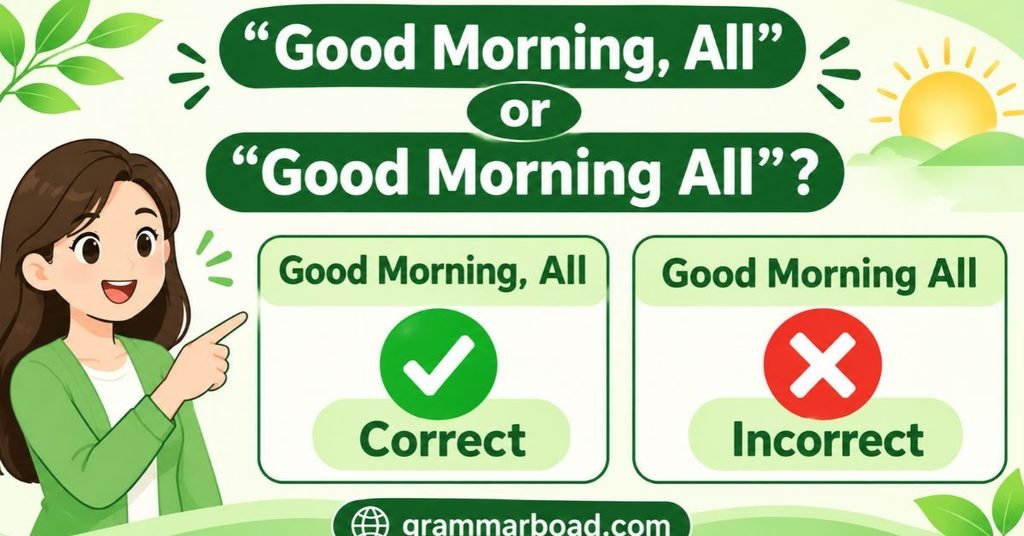
The same punctuation rule applies here. “Good morning, all” is the preferred form because the word “all” refers directly to the people being addressed.
For example:
- Preferred: Good morning, all. I hope everyone is doing well.
- Less standard: Good morning all. I hope everyone is doing well.
The comma helps separate the greeting from the group being addressed. It is especially useful in professional emails and formal communication.
Good Morning vs. Goodmorning in Emails
“Good morning” is a friendly and professional way to begin an email, especially when contacting colleagues, clients, teachers, or managers.
Here is an example:
Good morning, Daniel,
I wanted to follow up on yesterday’s meeting. Please let me know if you have any updates.
Best regards,
Alex
When writing an email greeting, remember these points:
- Write “good morning” as two words.
- Capitalize the first word at the beginning of the email.
- Use a comma when directly addressing someone by name.
- Keep your greeting polite and appropriate for the situation.
Avoid writing “Goodmorning” in professional emails because it is not the standard spelling.
Good Morning in Professional Communication
In professional communication, “good morning” is a respectful and neutral way to begin a conversation, meeting, or message.
You can use it when communicating with:
- Colleagues and coworkers
- Managers and supervisors
- Customers and clients
- Teachers and business partners
For example:
Good morning, everyone. Thank you for joining today’s meeting.
Using the correct spelling and punctuation helps your communication look clear, respectful, and professional.
Good Morning in Formal Writing
In formal situations, such as business letters, official announcements, speeches, and presentations, good morning should always be written as two words. Using the correct good morning spelling helps keep your communication clear and professional.
For example:
Good morning, ladies and gentlemen. Thank you for being here today.
When using good morning at the beginning of a sentence, capitalize the first word. When addressing someone directly, separate the greeting from the person’s name or title with a comma.
The joined spelling “goodmorning” should be avoided in formal writing. Always use good morning in professional communication.
Good Morning vs. Goodmorning in Text Messages
Text messages are usually informal, so people sometimes type quickly and accidentally leave out spaces.
You may see “goodmorning” in casual conversations, but that does not make it the correct spelling.
For example:
- Correct: Good morning! How did you sleep?
- Incorrect: Goodmorning! How did you sleep?
Even in informal messages, using two words is the better choice. It takes almost no extra effort and keeps your writing accurate.
Good Morning vs. Goodmorning on Social Media
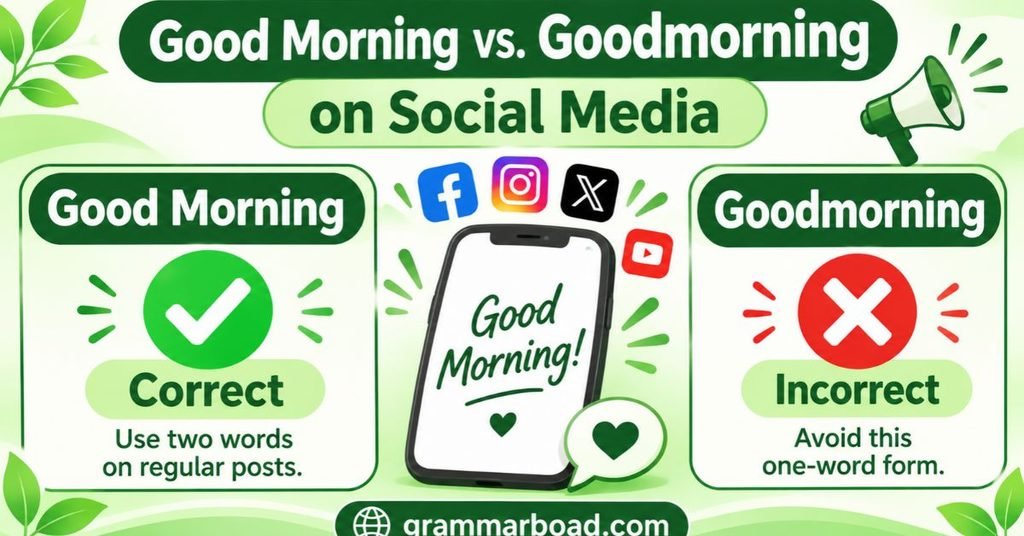
Social media is another place where the spelling “goodmorning” frequently appears.
People sometimes join words in captions, usernames, and hashtags to make them shorter or easier to use.
For example:
- Regular caption: Good morning, everyone! Have a wonderful day.
- Hashtag: #GoodMorning
- Incorrect standard spelling: Goodmorning, everyone!
Hashtags cannot contain spaces, so joining the words in #GoodMorning is acceptable in that specific format.
However, when writing an ordinary caption, comment, or post, always use “good morning” as two separate words.
Why Do People Write “Goodmorning”?
There are several reasons why people write “goodmorning” instead of the correct two-word expression “good morning.”
1. Typing Quickly
People sometimes type too quickly and accidentally leave out the space between the words when writing good morning.
2. Similar Pronunciation
When spoken aloud, “good morning” flows naturally, which may make it sound like a single word.
3. Social Media Habits
Joined words are common in hashtags and usernames, so people sometimes use the same spelling when posting a good morning message in regular sentences.
4. Similar English Words
English contains joined words such as “goodbye” and “goodwill.” This may make “goodmorning” look reasonable to some writers.
Although these reasons explain the confusion, they do not change the standard spelling rule: “good morning” is always written as two words in standard English.
Is “Goodmorning” Ever Correct?
In standard English writing, “goodmorning” is not the correct spelling. The accepted expression is always “good morning,” which is the proper way to write this common greeting.
However, the joined form may appear as a deliberate creative choice in certain situations, such as:
- A brand name
- A social media username
- A website name
- A hashtag
These special uses do not make “goodmorning” grammatically correct in ordinary English sentences or formal good morning messages.
For everyday writing, always use the two-word version “good morning.”
Good Morning vs. Goodmorning: Easy Memory Trick
Here is a simple trick to remember the correct spelling of good morning: Keep “good” and the time-of-day word separate.
For example:
- Good morning
- Good afternoon
- Good evening
All three greetings are written as two words.
You can also remember that “good” is an adjective and “morning” is a noun. Since they work as separate words, you should keep the space between them.
Whenever you are unsure about good morning vs. goodmorning, remember to choose the two-word spelling “good morning.”
What About “Morning” by Itself?
“Morning” by itself is also a perfectly natural greeting in English. It is a shorter and more casual version of “good morning.”
People commonly use it with friends, family members, and coworkers.
For example:
- Morning, Sam! How are you?
- Morning! Did you have a good weekend?
- Morning, everyone. Ready to get started?
Although “morning” is perfectly acceptable in casual conversations, “good morning” is generally a better choice for formal situations and professional communication.
Also Read This:https://grammarboad.com/writing-or-writting/
Good Morning vs. Goodmorning: Which One Should You Use?
You should always use “good morning” in standard English writing. It is the correct spelling for emails, letters, school assignments, text messages, social media captions, and professional communication.
“Goodmorning” may appear in usernames, brand names, and hashtags, but it is not accepted as the standard spelling in ordinary sentences.
The easiest way to remember the rule is that “good” and “morning” are two separate words. Keep the space between them whenever you write this greeting.
FAQs
1. Is it “good morning” or “goodmorning”?
“Good morning” is correct. It is written as two separate words in standard English. “Goodmorning” is a spelling mistake.
2. Is “goodmorning” in the dictionary?
No. “Goodmorning” is not generally recognized as a standard English word. The accepted expression is “good morning.”
3. Do I capitalize “good morning”?
Capitalize “Good” when the greeting begins a sentence or message. Use lowercase when it appears in the middle of a sentence.
4. Should there be a comma after “good morning”?
Use a comma when directly addressing someone by name or group. For example: “Good morning, Maria.”
5. Is it okay to use “goodmorning” in a hashtag?
Yes. Hashtags cannot contain spaces, so #GoodMorning is an acceptable hashtag format. However, use “good morning” in ordinary sentences.
6. Can I just say “morning” instead of “good morning”?
Yes. “Morning!” is a natural, casual greeting. However, “good morning” is more suitable for formal and professional situations.
Conclusion
When it comes to good morning vs. goodmorning, the correct choice is simple: always write “good morning” as two separate words. The expression combines an adjective and a noun, and the joined spelling “goodmorning” is not accepted in standard English.
Remember to capitalize the first word at the beginning of a sentence, use a comma when addressing someone directly, and maintain the correct spelling in emails, formal writing, and everyday messages. Following this simple rule will help you communicate clearly and confidently in English.