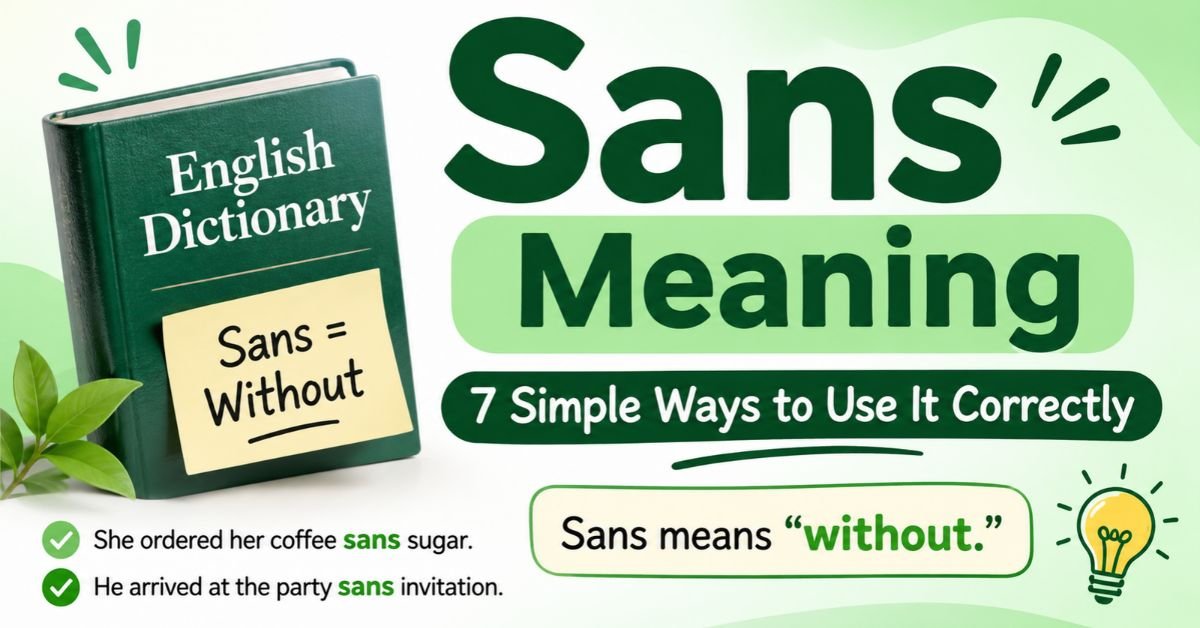
You have probably seen “sans” in a menu, a caption, a font name, or a witty social media post and wondered whether it was a real English word. It is, and the sans meaning is simple: “without.” Understanding the Sans Meaning can help you recognize how this somewhat old-fashioned and playful word works in different contexts and when it may sound forced.
This guide explains what “sans” means, where it comes from, how to pronounce it, and how to use it correctly and confidently in English.
Quick Answer
“Sans” is a preposition that means “without.” The Sans Meaning comes from French and is used in English to create a slightly formal, stylish, literary, or humorous effect. Understanding the sans meaning makes it easier to recognize how this word adds a distinctive tone to everyday sentences.
TL;DR
- Meaning: Without
- Part of speech: Preposition
- Pronunciation: SANZ (rhymes with “fans”)
- Origin: Old French, derived from Latin sine
- Tone: Playful, stylish, or literary rather than neutral
- Best alternative: “Without,” which works in almost every context
What “Sans” Means in English
In English, “sans” means “without” or “lacking something.” It appears directly before the thing that is missing:
- A burger sans bun
- Sans warning, the power went out.
- He walked into the meeting sans notes.
Because it is a borrowed word, “sans” carries a hint of flair that the ordinary word “without” does not. Writers often choose it to add humor, elegance, or a light, conversational touch to their sentences.
Origin and History of “Sans”
“Sans” entered English from Old French, where sans also meant “without.” The French word developed from the Latin sine, which had the same meaning. Understanding the Sans Meaning also involves knowing its French and Latin origins. English began borrowing it during the Middle English period, when French had a significant influence on the English language following the Norman Conquest.
The word also has a long literary history. Shakespeare used it, most famously in a speech in As You Like It that describes the losses associated with old age. This literary history helped establish “sans” as a slightly theatrical and old-fashioned word, which is part of why it still feels stylish today.
Part of Speech and Grammar Role
“Sans” is a preposition. Like “with” and “without,” it introduces a noun or noun phrase that identifies something missing. Understanding the Sans Meaning and its grammatical role helps you use the word correctly in English sentences.
Here are some common patterns:
- Sans + noun: sans sugar, sans apology
- Sans + pronoun: sans him (less common)
- Sans + noun phrase: sans any real plan
The word does not change its form. It has no plural form, past tense, or other grammatical variations to remember.
For example, write “sans warning,” not “sans warn.”
Pronunciation of “Sans”
In English, “sans” is pronounced /sænz/. Understanding the Sans Meaning also includes learning its correct pronunciation. It sounds like “SANZ” and rhymes with “fans” and “plans.” The final “s” is pronounced like a “z.”
In French, the word is pronounced more like “sahn,” with a nasal vowel and a silent final consonant. Some English speakers use the French pronunciation for stylistic reasons, but the English pronunciation is standard in everyday English speech. Knowing the Sans Meaning and its pronunciation can help you use this word confidently in English.
How to Use “Sans” in a Sentence
To use “sans” correctly, place it directly before the noun or noun phrase that describes something missing.
Examples:
- She showed up sans makeup and looked perfectly happy.
- The report was sent sans attachments.
- They finished the trip sans luggage after the airline lost it.
It usually appears in the middle or toward the end of a sentence. It can also appear at the beginning when the writer wants to create a particular literary or dramatic effect.
Everyday Usage of “Sans”
The Sans Meaning becomes easier to understand when you see how “sans” appears in several everyday contexts, especially in writing and creative expressions.
- Food and drink: A latte sans foam, pasta sans cheese.
- Social media and captions: Monday sans coffee.
- Typography: Sans-serif describes a typeface without the small decorative strokes at the ends of letters. Arial and Helvetica are common examples.
- Humor and storytelling: He faced the storm sans umbrella.
The typography expression is one of the most familiar uses of the word. “Sans-serif” literally means “without serifs.” Knowing the Sans Meaning helps you understand expressions like “sans-serif” and use them correctly. The Sans Meaning also adds a stylish touch to everyday English expressions.
Formal vs. Informal Tone
The Sans Meaning is closely connected to tone and context. “Sans” sits somewhere between formal and informal language. It is not exactly slang, but it is not a neutral everyday word either. Its tone depends on the context.
- Informal writing: It sounds playful or witty. Dinner sans dessert is a crime.
- Literary writing: It can add an old-fashioned, dramatic, or elegant touch.
- Formal or professional writing: It may feel out of place. Reports, legal documents, and academic papers generally favor “without.”
If you are unsure whether to use it, consider your audience and the overall tone of your writing. Understanding the Sans Meaning and its tone can help you decide when it is appropriate. If a little personality suits the piece, “sans” may work well. Otherwise, choose “without” for clearer and more neutral communication.without.”
“Sans” vs. “Without”
“Sans” and “without” have the same basic meaning, but they create different impressions.
| Feature | Sans | Without |
| Meaning | Without or lacking | Without or lacking |
| Tone | Stylish, playful, literary | Neutral and universal |
| Best for | Captions, humor, creative writing | Almost any context |
| Risk | Can sound pretentious if overused | Rarely sounds unnatural |
| Example | Tea sans sugar | Tea without sugar |
“Without” is the safer and more widely used choice. “Sans” is a stylistic alternative that adds personality when the context supports it.
7 Simple Ways to Use “Sans” Correctly
Understanding the Sans Meaning and following a few simple grammar rules can help you use this word correctly and confidently in everyday English.
1. Put it directly before the missing item.
Write sans sugar, not sugar sans.
2. Follow it with a noun or noun phrase.
Examples include sans warning and sans any explanation.
3. Use it for light humor.
For example: He tackled the project sans sleep, sans patience, and sans mercy.
4. Match it to the tone of your writing.
It works well in blogs, captions, and creative writing, but it may feel out of place in a professional email.
5. Avoid overusing it.
One or two uses in a piece can add flair. Repeating it too often can make your writing sound forced.
6. Use the correct English pronunciation.
Say it with a final “z” sound rather than making the final consonant silent.
7. Keep “without” as your backup.
If “sans” sounds unnatural in a sentence, replace it with “without.” Clear writing is always better than unnecessarily complicated wording.
Remembering the Sans Meaning and these seven practical tips will make it easier to use the word naturally in different writing situations.
Common Examples in Sentences
Here are some additional examples that show how “sans” works in different situations:
- She enjoyed her morning walk sans phone.
- The sandwich arrived sans pickles, as requested.
- He gave the speech sans notes and still impressed everyone.
- The team launched the update sans fanfare.
- They hiked the trail sans map and got a little lost.
- The website looks cleaner sans pop-ups.
- Sans a clear plan, the project drifted for weeks.
These examples show that “sans” can describe missing objects, qualities, or resources in different situations.
Synonyms and Alternatives to “Sans”
If “sans” does not fit your sentence, you can use several alternatives depending on the meaning and tone you want.
- Without: The standard, all-purpose choice. Example: Coffee without sugar.
- Lacking: Used to describe something that does not have a particular quality. Example: A design lacking creativity.
- Minus: An informal alternative. Example: Coffee minus the caffeine.
- Free of / Free from: Used when something does not contain or have something. Example: A product free of artificial colors.
- Devoid of: A more formal alternative. Example: A speech devoid of emotion.
- Absent: Used to indicate that something is missing. Example: A meeting absent any clear agenda.
Choose the alternative that sounds most natural in your sentence.
When to Use “Sans”
“Sans” is a good choice in the following situations:
- When writing casually and adding a little personality.
- When creating humorous captions or social media posts.
- When writing creative or literary content.
- When describing food, fashion, or lifestyle choices.
- When discussing typography, especially the term “sans-serif.”
- When your readers understand the word and appreciate its stylistic effect.
When Not to Use “Sans”
Although “sans” is a correct English word, it is not suitable for every situation.
Avoid using it when:
- You are writing formal documents, such as contracts, academic papers, or official reports.
- Your audience may not recognize the word, especially beginner English learners.
- Clarity matters more than style, such as in instructions or safety notices.
- You have already used it repeatedly in the same piece.
- The sentence sounds more natural and straightforward with “without.”
In these situations, choosing a familiar word can make your writing easier to understand.
Common Mistakes
Here are some common mistakes to avoid when using “sans” in English:
1. Using it as a verb or adjective. “Sans” functions as a preposition, not a verb. Writing He sansed the sugar is incorrect.
2. Placing it after the noun. Writing sugar sans is incorrect in standard English. The natural order is sans sugar.
3. Adding an unnecessary “of.” The expression sans of sugar is incorrect. Write sans sugar instead.
4. Mispronouncing the ending. In standard English pronunciation, the final “s” sounds like “z.”
5. Using it in unsuitable formal writing. Although grammatically correct, “sans” can make serious or professional writing sound overly stylish.
6. Overusing it. Repeating “sans” too often can make your writing feel unnatural or unnecessarily complicated.
Also Read This:https://grammarboad.com/smaragdine-meaning/
Is “Sans” Still Commonly Used in Modern English?
Yes, although its use is somewhat limited. “Sans” is not a word most people use regularly in everyday conversation, but it remains familiar in written English, particularly in humorous, informal, and creative contexts.
It is also widely recognized through the expression “sans-serif” in typography.
Think of “sans” as a stylistic word. You may encounter it often enough to recognize it, and you can use it occasionally to add personality to your writing. However, “without” remains the more common and versatile choice.
FAQs
1. What does “sans” mean?
“Sans” means “without.” For example, sans sugar means without sugar.
2. Is “sans” an English word?
Yes. “Sans” is a French loanword that has been used in English for centuries and is included in standard English dictionaries.
3. How do you pronounce “sans”?
In standard English, it is pronounced “SANZ,” rhyming with “fans.”
4. What does “sans-serif” mean?
“Sans-serif” describes a typeface without serifs, which are the small decorative strokes at the ends of letters. The term literally means “without serifs.”
5. Can I use “sans” in formal writing?
It is generally better to use “without” in formal writing. “Sans” can sound playful or stylistic, depending on the context.
6. Is “sans” the same as “without”?
Yes, both words express the same basic meaning. However, “sans” sounds more stylish or literary, while “without” is neutral and widely used.
7. Is “sans” a preposition?
Yes. “Sans” is a preposition that comes before a noun or noun phrase to indicate something that is missing.
Conclusion
The sans meaning is easy to remember: it simply means “without.” Borrowed from French, this word adds a touch of style, humor, and personality to English writing. It is particularly useful in casual captions, creative content, and expressions such as “sans-serif.”
To use it correctly, place it before the missing item and choose it when its stylish tone suits your writing. Avoid overusing it, especially in formal situations where “without” is usually the better choice.
Once you understand its meaning and usage, you can use “sans” confidently and make your English writing more expressive.