Have you ever wondered whether to write realize or realise? You’re not alone. Many students, writers, and English learners get confused about which spelling is correct. The good news is that both forms are correct and have exactly the same meaning. The main difference is regional spelling preference.
In American English, realize is the standard spelling, while realise is commonly used in British, Australian, and New Zealand English. However, some British publishers also prefer the “-ize” spelling.
In this guide, you’ll learn the meanings, origins, spelling differences, pronunciation, grammar rules, and examples of both words so you can choose the right form for your writing.
Realize or Realise – Quick Answer
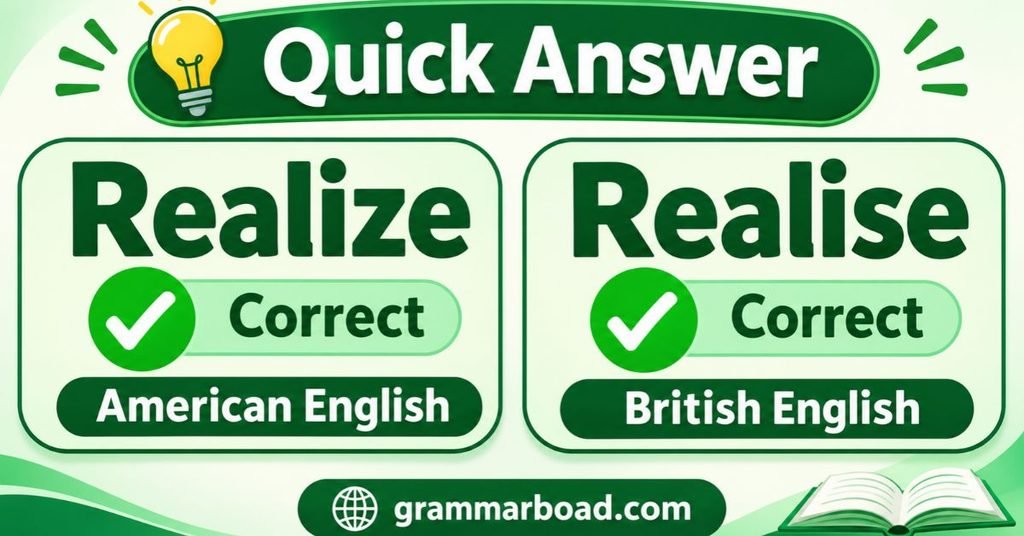
Both realize and realise are correct spellings of the same English verb.
- Realize: The standard spelling in American English and commonly used in Canadian English.
- Realise: The preferred spelling in most British, Australian, and New Zealand writing.
Both words mean to become aware of something, understand a situation, or achieve something.
Examples:
- American English: I didn’t realize how important the meeting was.
- British English: I didn’t realise how important the meeting was.
The pronunciation and meaning are identical. Choose the spelling that matches your audience and use it consistently.
What Does Realize Mean in English?
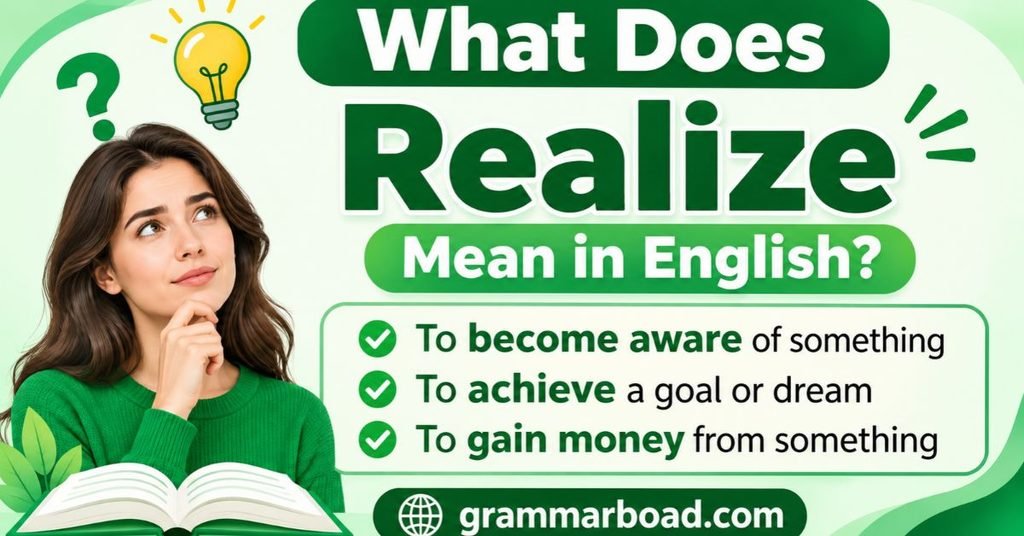
Realize is a verb commonly used in American English. It has several meanings depending on the context.
- To become aware of something: To understand or recognize a fact or situation.
I realized that I had forgotten my keys at home. - To achieve something: To make an idea, plan, or dream become real.
She finally realized her dream of becoming a teacher. - To gain money from something: To receive money by selling an asset or making a financial transaction.
The company realized a profit from the sale.
The word can be used in everyday conversations, academic writing, business communication, and formal documents.
What Does Realise Mean in English?
Realise is the British English spelling of the same verb. It has exactly the same meanings as realize.
It can describe understanding something, becoming aware of a situation, achieving a goal, or receiving money from a financial transaction.
Examples:
- I didn’t realise how late it was.
- He realised that he had made a mistake.
- She worked hard to realise her dream.
- The business realised a profit last year.
There is no difference in meaning or grammar between the two spellings. The choice depends mainly on regional spelling conventions.
Is Realize or Realise Correct?
Both spellings are correct. Neither is a grammatical mistake or an incorrect version of the word.
The difference comes from the variety of English being used.
- Realize is standard in American English.
- Realise is preferred in most British English publications.
- Both forms are used in British English because some publishers follow Oxford spelling conventions.
For example, an American writer would normally write:
I didn’t realize my mistake until later.
A British writer following the common “-ise” convention would write:
I didn’t realise my mistake until later.
The important rule is to follow one spelling style throughout your writing.
Is Realize American or British English?
Realize is the standard spelling in American English. It is also commonly used in Canadian English.
However, it is not exclusively an American spelling. Some British publishers, including Oxford University Press, use the “-ize” ending as part of their preferred spelling style.
This convention is often called Oxford spelling.
Therefore, both realize and realise can appear in British English, depending on the publisher’s style guide.
Is Realise Used in American English?
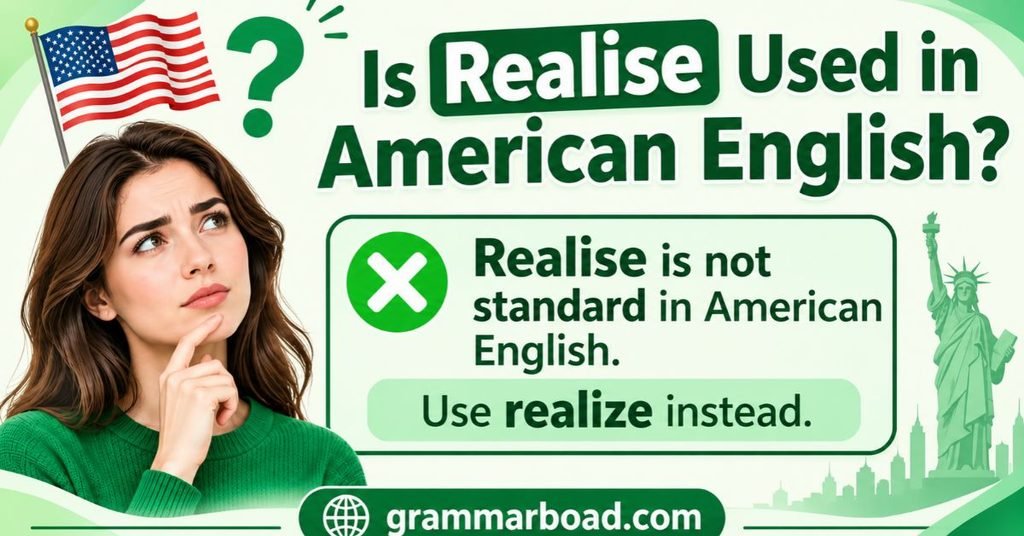
The spelling realise is not standard in American English. American dictionaries, editors, and spellcheckers generally prefer realize.
Although American readers can understand realise, it may be marked as a spelling error by software set to US English.
Example:
- Standard American English: I realize the importance of education.
- Standard British English: I realise the importance of education.
If you’re writing for an American audience, use realize to follow the usual American spelling convention.
The Origin of Realize or Realise
The word realize comes from the French word réaliser, which is related to réel, meaning real. The French word ultimately traces back to the Latin realis, meaning relating to things.
The English verb appeared in the 17th century. Its “-ize” ending is connected to the Greek-derived suffix “-izein,” which entered English through Latin and French.
Over time, both “-ize” and “-ise” spellings became established in English.
Today, the “-ize” form is standard in American English and is also used by some British publishers. The “-ise” form is preferred in most British, Australian, and New Zealand writing.
This history explains why realize is not simply an American invention.
British English vs American English Spelling
British and American English use different spelling conventions for many words. The realize and realise difference is one example of this broader pattern.
Here are some common examples:
| American English | British English |
| Realize | Realise |
| Organize | Organise |
| Recognize | Recognise |
| Apologize | Apologise |
| Criticize | Criticise |
| Summarize | Summarise |
However, British English is not completely uniform. Some British publishers and academic institutions use Oxford spelling, which prefers “-ize” in words such as organize and realize.
Australian and New Zealand English generally prefer “-ise,” while Canadian English commonly uses “-ize.”
It’s also important to remember that some words always end in “-ise” in both varieties of English, such as:
- Advertise
- Surprise
- Exercise
- Revise
These words do not follow the optional “-ize” and “-ise” spelling pattern.
Realize vs Realise Pronunciation Differences
One interesting fact about realize and realise is that their pronunciation is exactly the same.
Both words are generally pronounced as:
REE-uh-lyze
The final sound is a voiced “z,” not an “s” sound.
The pronunciation may vary slightly depending on the speaker’s accent, but the spelling does not change how the word is pronounced.
Examples:
- American pronunciation: Realize
- British pronunciation: Realise
Both have the same pronunciation and meaning.
Realize vs Realise Meaning and Definition
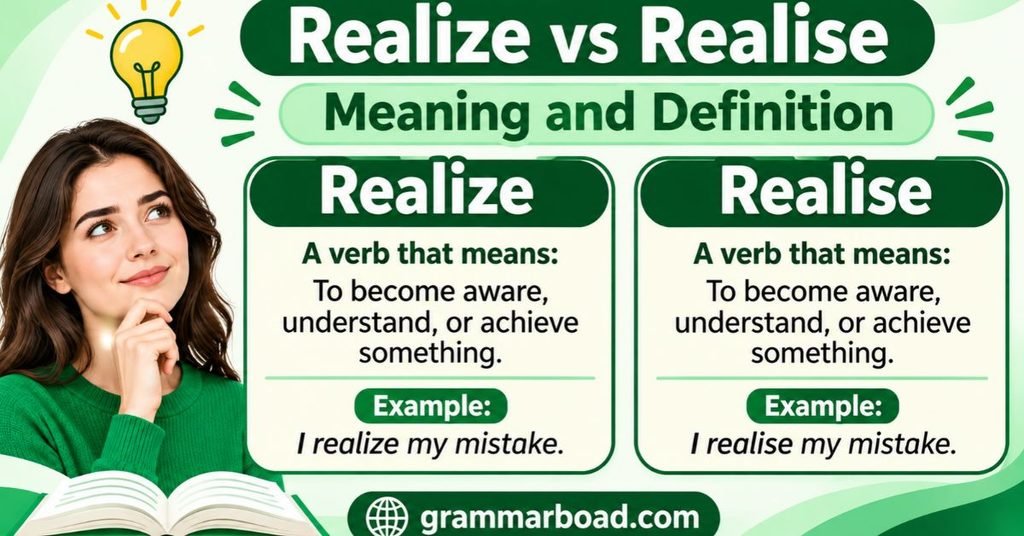
There is no difference in meaning between realize and realise. Both words describe the same actions and situations.
The following table explains their shared meanings:
| Meaning | Realize Example | Realise Example |
| Become aware | I realize you’re busy. | I realise you’re busy. |
| Understand something | She realized her mistake. | She realised her mistake. |
| Achieve a goal | They realized their dream. | They realised their dream. |
| Gain financially | He realized a profit. | He realised a profit. |
As you can see, only the spelling changes. The meaning remains exactly the same.
Which Spelling Should You Use?
Choosing between realize and realise depends on your audience and the type of English you’re using.
Here are some simple guidelines:
- For American readers: Use realize.
- For Canadian readers: Realize is generally preferred.
- For British readers: Use realise unless your publisher or style guide specifies Oxford spelling.
- For Australian readers: Use realise.
- For New Zealand readers: Use realise.
- For international writing: Choose one spelling convention and maintain consistency.
If you’re writing a blog, article, academic paper, or business document, consistency is especially important.
Always check the relevant style guide before submitting formal writing.
When to Use Realize in a Sentence
Use realize when writing in American English, Canadian English, or a publication that follows Oxford spelling.
Here are some examples:
- I didn’t realize the meeting had been postponed.
- Many people realize the value of sleep after experiencing exhaustion.
- She wants to realize her dream of becoming a doctor.
- Do you realize how important this opportunity is?
- He realized that he had made the wrong decision.
- The company realized a significant profit last year.
In each example, realize follows standard American spelling conventions.
When to Use Realise in a Sentence
Use realise when writing in British, Australian, or New Zealand English.
Here are some examples:
- I didn’t realise the shop closed so early.
- She realised that she had taken the wrong train.
- It took him years to realise his potential.
- Do you realise how much time this project requires?
- He realised his mistake after reading the instructions.
- They worked hard to realise their ambitions.
These examples follow the common British “-ise” spelling convention.
Common Mistakes with Realize or Realise
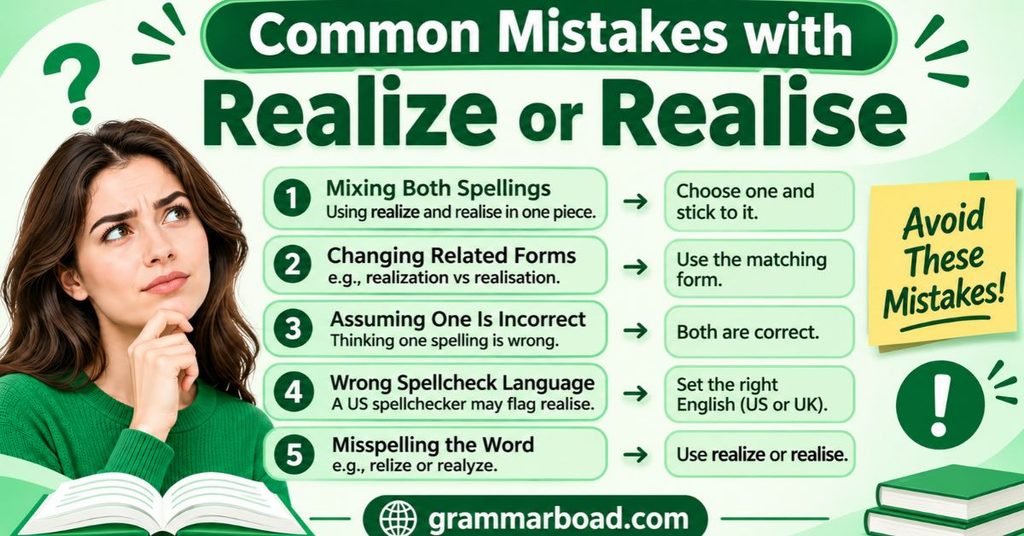
Writers sometimes make simple spelling mistakes when choosing between realize and realise. Here are some common errors to avoid.
1. Mixing Both Spellings
Using realize in one paragraph and realise in another can make your writing inconsistent.
Correction: Choose one spelling style and follow it throughout your article.
2. Changing the Spelling of Related Words
If you use realize, the related forms should generally be realization, realized, and realizing.
If you use realise, choose realisation, realised, and realising.
3. Assuming One Spelling Is Incorrect
Neither realize nor realise is wrong. Both are accepted English spellings.
Correction: Choose according to your audience and style guide.
4. Using the Wrong Spellcheck Language
A spellchecker set to American English may flag realise as an error, even though it is correct in British English.
Correction: Set your writing software to the appropriate English variety.
5. Misspelling the Word
Incorrect forms such as “relize” and “realyze” are not accepted standard spellings.
Correction: Always use realize or realise.
Realize or Realise in Everyday Examples
Both spellings appear in everyday conversations, text messages, social media posts, and emails.
Here are some examples showing how the choice changes depending on the audience.
- Text message (US): Just realized I forgot my charger.
- Text message (UK): Just realised I’ve left my charger at home.
- Social media (US): Never realized how good coffee could be.
- Social media (UK): Never realised how much I love coffee.
- Email (US): I realize this is short notice.
- Email (UK): I realise this is short notice.
These examples show that the meaning remains the same, even when the spelling changes.
Realize vs Realise in Formal Writing
In formal writing, including business letters, reports, and official documents, choosing the correct regional spelling is important.
Here are a few examples:
- A US company writing a business report would normally use realize.
- A British company following the common “-ise” convention would use realise.
- A British publisher following Oxford spelling may use realize.
- An international organization should follow its established style guide.
Before preparing a formal document, check the organization’s spelling preferences.
Consistency helps make your writing look professional and polished.
Realize vs Realise in Academic Writing

Academic writing follows the spelling conventions of the university, journal, or publication.
Some British universities accept both spellings, provided students use one form consistently. Other institutions and academic journals require a particular spelling style.
For example, publications following Oxford spelling may use realize, even in British English contexts.
Before submitting an assignment, research paper, or academic article, check the submission guidelines.
If no specific style is required, follow the spelling convention commonly used in your institution or country.
Realize vs Realise: Verb Forms and Tenses
Both realize and realise follow the same regular verb pattern. Only their spelling changes.
Here is a comparison of their different forms:
| Form | “-ize” Spelling | “-ise” Spelling |
| Base form | Realize | Realise |
| Third-person singular | Realizes | Realises |
| Past tense | Realized | Realised |
| Past participle | Realized | Realised |
| Present participle | Realizing | Realising |
| Noun | Realization | Realisation |
Examples in Different Tenses:
- Present: I realize / realise the problem.
- Past: She realized / realised her mistake immediately.
- Future: You will realize / realise the importance of this lesson.
- Present perfect: We have realized / realised how much we need to improve.
Both forms follow the same grammatical rules.
Synonyms and Alternatives for Realize and Realise
If you want to avoid repeating realize or realise, you can use alternative words depending on the meaning of the sentence.
For Becoming Aware:
- Understand
- Recognize / Recognise
- Notice
- Grasp
- See
- Appreciate
For Achieving Something:
- Accomplish
- Achieve
- Fulfil / Fulfill
- Attain
- Make happen
For Financial Gain:
- Earn
- Make
- Gain
- Profit
Remember that some alternatives have their own British and American spelling differences. Always select the form that suits your audience.
How to Remember the Difference Between Realize and Realise
Remembering the difference between realize and realise is easy once you understand the regional spelling patterns.
Here are a few helpful tips:
- Z for American English: Associate the letter Z with the American spelling realize.
- S for British English: Remember that realise is preferred in most British writing.
- Check Your Keyboard Settings: Your spelling suggestions may depend on whether your device uses US or UK English.
- Follow One Style: Choose your preferred spelling before writing and maintain it throughout the document.
These simple tricks can help you avoid spelling confusion.
Realize vs Realise: Examples in British and American English
The following table provides additional examples of both spellings in different contexts.
| Context | American English | British English |
| Understanding | I realize I was wrong. | I realise I was wrong. |
| Achievement | He realized his dream. | He realised his dream. |
| Noun form | The realization was surprising. | The realisation was surprising. |
| Question | Did you realize it was today? | Did you realise it was today? |
| Continuous | We’re realizing our potential. | We’re realising our potential. |
The examples demonstrate how regional spelling conventions affect the written form without changing the meaning.
Also Read This:https://grammarboad.com/kiss-emoji-meaning/
Realize or Realise – Google Trends & Usage Data
The popularity of realize and realise varies across English-speaking regions.
Generally, realize is associated with American and Canadian writing, while realise is commonly associated with British, Australian, and New Zealand writing.
However, actual search interest changes over time and depends on the selected country and date range.
Google Trends can help compare the relative search interest for both spellings.
To explore the difference:
- Visit Google Trends.
- Search for “realize” and “realise.”
- Select the country you want to examine.
- Choose a suitable time range.
- Compare the search interest for both terms.
Remember that Google Trends displays relative search interest rather than exact monthly search volumes.
Realize or Realise Comparison Table
Here is a quick comparison to help you understand the main differences between realize and realise.
| Feature | Realize | Realise |
| Correct spelling? | Yes | Yes |
| Main regions | US and Canada | UK, Australia, NZ |
| Meaning | Identical | Identical |
| Pronunciation | Same | Same |
| Noun form | Realization | Realisation |
| Past tense | Realized | Realised |
| Present participle | Realizing | Realising |
| British usage | Oxford spelling | Common UK spelling |
| Best for | US and Canadian audiences | Most UK, Australian, and NZ audiences |
FAQs
Is it realize or realise?
Both are correct. Realize is standard in American English, while realise is preferred in most British, Australian, and New Zealand writing.
Is “realise” wrong in American English?
Realise is understandable but is not the standard American spelling. American writers generally use realize.
Do realize and realise mean different things?
No. Both words have exactly the same meanings and pronunciation. The only difference is their spelling.
Is “realize” an American spelling only?
No. Although realize is standard in American English, it is also used in Canadian English and by some British publishers that follow Oxford spelling.
Which spelling is older?
Both spellings have a long history in English. The “-ize” ending is connected to the Greek-derived suffix “-izein,” while “-ise” is an established spelling variant. It is better not to treat one as universally older in modern usage.
Can I use both spellings in one document?
It is best to avoid mixing them. Choose one spelling convention and use it consistently, including related words such as realization or realisation.
Which spelling should I use for an international audience?
Choose the spelling that matches your main readership or the style guide used by your organization. Consistency is more important than choosing one form over the other.
Is realize pronounced with a Z or S sound?
Both realize and realise are pronounced with a voiced Z sound at the end. Their pronunciation is the same.
What is the noun form of realize or realise?
The noun form is realization in American English and realisation in most British English writing.
Does Canada use realize or realise?
Canadian English generally prefers realize, although individual publications may follow their own spelling guides.
Conclusion
The difference between realize vs realise is mainly about regional spelling preferences, not meaning or pronunciation. Both forms are correct and can be used to express awareness, understanding, achievement, or financial gain.
Use realize when writing for American and Canadian audiences, and realise when following the common British, Australian, or New Zealand spelling convention. Remember that some British publishers also use realize.
The most important rule is to stay consistent throughout your writing. Once you understand these spelling differences, choosing the correct form becomes much easier.