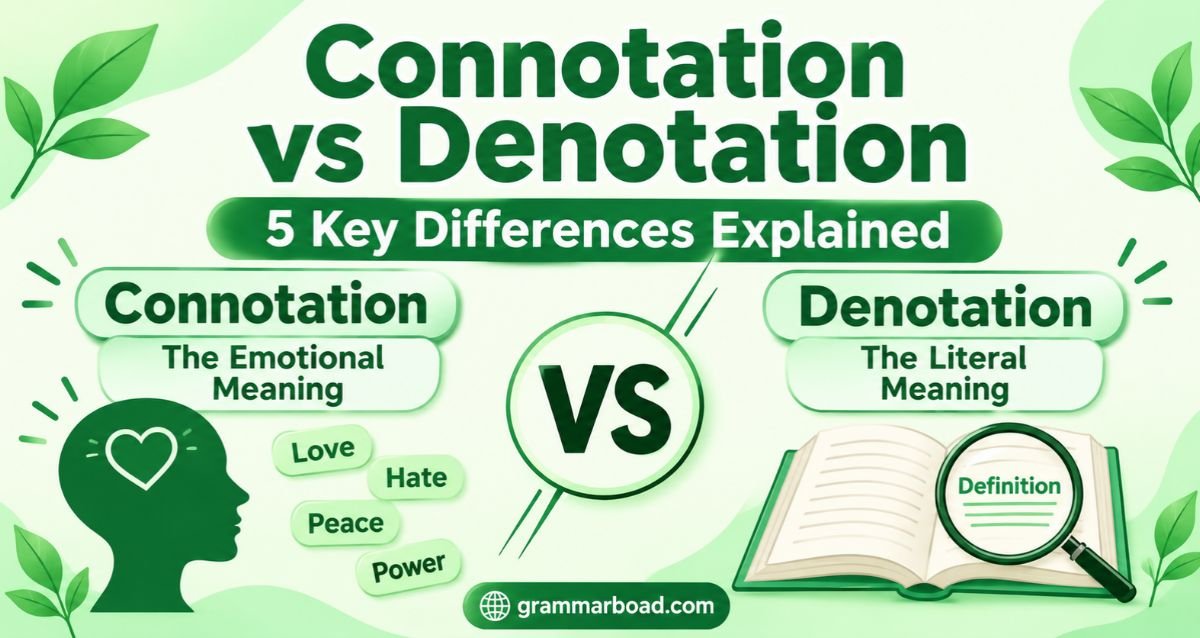
Every word carries two layers of meaning. One is the plain definition you would find in a dictionary. The other is the feeling, association, or cultural meaning a word brings with it. Understanding connotation vs denotation helps you read more carefully, write more precisely, and choose words that communicate exactly what you intend.
This guide explains both concepts in simple terms, explores their differences through clear examples, and highlights five key distinctions:
- Source of meaning: Denotation comes from a dictionary definition, while connotation develops through culture, experience, and context.
- Nature: Denotation is literal and objective, while connotation is emotional and subjective.
- Stability: Denotation is generally stable, while connotation can change between people, places, and generations.
- Purpose: Denotation provides information, while connotation influences tone and feelings.
- Typical use: Denotation is especially important in technical and academic writing, while connotation is widely used in literature, advertising, and everyday communication.
What Is Connotation in English?
The connotation meaning of a word refers to the emotions, feelings, and associations it creates beyond its literal definition. It is the feeling attached to a word rather than its basic dictionary definition.
Consider the word home. Its literal meaning is a place where someone lives. However, home can also suggest warmth, safety, family, and belonging. These additional feelings are its connotations.
Connotations are shaped by culture, personal experiences, history, and context. Because of this, they are not always the same for everyone. A word that feels comforting to one person may seem neutral or even unpleasant to another.
Understanding connotation is an essential part of Connotation vs Denotation because it helps readers recognize the emotions and associations behind everyday words. It also makes it easier to choose vocabulary that expresses the intended tone.
What Is Denotation in English?
The denotation meaning of a word refers to its exact dictionary definition without additional emotional associations. It describes what a word means in its most basic sense, without adding emotional associations or suggestions.
For example, the denotation of winter is the coldest season of the year in a region with four distinct seasons. The denotation of dog refers to a domesticated canine animal. These definitions explain what the words mean without suggesting additional feelings.
Denotation answers a simple question: “What does this word actually mean?” In Connotation vs Denotation, denotation represents the literal definition, helping readers understand the exact meaning of words without confusing it with emotional associations.
How Connotation Changes the Meaning of Words
Connotation can change how a sentence is understood, even when the basic idea remains similar. Consider these two sentences:
- She is a curious child.
- She is a nosy child.
Both sentences describe a child who asks many questions, but curious sounds positive, while nosy sounds critical. The choice of word changes the impression a reader receives.
This is why connotation matters in persuasion, storytelling, and everyday conversation. Writers and speakers choose words not only for what they communicate but also for how they make their audience feel.
This difference is an important part of Connotation vs Denotation. While the denotation of a word explains its basic meaning, its connotation influences how readers interpret the message and respond emotionally.
How Denotation Defines a Word
Denotation gives a word its basic meaning. It provides a shared definition that helps people understand one another, regardless of their backgrounds or personal experiences.
For example, when you look up chair in a dictionary, you will find a definition describing a seat designed for one person, usually with a back and legs. This is its denotation.
Denotation also provides the foundation for learning vocabulary. You usually learn a word’s dictionary meaning first and understand its emotional associations over time through reading, conversation, and experience.
Understanding Connotation vs Denotation allows readers to distinguish between a word’s literal definition and the additional feelings or ideas it may suggest in different situations.
Positive Connotation Examples
A word has a positive connotation when it suggests something favorable, pleasant, or admirable.
Here are some common examples:
- Slender: Suggests an attractive or graceful body shape.
- Confident: Suggests healthy self-belief and assurance.
- Frugal: Suggests wise and careful spending.
- Childlike: Often suggests innocence, curiosity, and wonder.
- Determined: Suggests admirable persistence and commitment.
These words can create a positive impression and help writers communicate ideas in a favorable way.
Negative Connotation Examples
A word has a negative connotation when it suggests something unfavorable, unpleasant, or critical.
Here are some examples:
- Arrogant: Suggests excessive pride or an exaggerated sense of importance.
- Stingy: Suggests an unwillingness to spend money or share with others.
- Childish: Suggests immaturity or a lack of good judgment.
- Stubborn: Suggests an unreasonable refusal to change.
- Cheap: When describing a person, it can suggest an unwillingness to spend money, even when necessary.
Notice how some words have positive or neutral alternatives with similar basic meanings. For example, frugal and stingy both describe careful spending, but they create very different impressions.
Neutral Connotation Examples
Some words have little emotional association in ordinary contexts. They mainly identify or describe something without creating a strong positive or negative impression.
Examples include:
- Table
- Book
- Window
- Road
- Notebook
Neutral words are common in instructions, reports, and factual writing, where the main goal is to provide information rather than influence the reader.
However, even seemingly neutral words can develop emotional associations in particular situations.
Common Examples of Connotation and Denotation
The following table shows how a word can have a literal meaning and an additional suggested meaning.
| Word | Denotation | Connotation |
| Home | A place where someone lives | Comfort, safety, and belonging |
| Snake | A long, legless reptile | Danger, deceit, or betrayal |
| Rose | A flowering plant with thorny stems | Love, romance, and beauty |
| Winter | The coldest season of the year | Loneliness, quiet, or hardship |
| Dove | A type of bird | Peace and gentleness |
| Fox | A small wild mammal | Cleverness or cunning |
| Blue | A color | Calmness or sadness |
These examples make Connotation vs Denotation easier to understand by showing how words communicate both literal definitions and additional emotional associations. Recognizing these differences can improve your vocabulary and writing skills.
Connotation vs Denotation in Everyday Language
You use both types of meaning regularly, often without realizing it. Understanding Connotation vs Denotation helps you recognize how different word choices can communicate the same basic idea while creating completely different impressions.
The same thing happens in the workplace. Describing a colleague as assertive sounds different from calling them aggressive. Telling a friend you are thrifty creates a different impression from saying you are cheap.
Everyday communication is full of these small word choices, which can influence how people understand your message.
Why Connotation Matters in Communication
Connotation shapes tone, and tone affects how your message is received. Choosing a word with the wrong connotation can make you sound harsh, insincere, or confusing, even when your facts are correct.
Connotation also plays an important role in several areas:
- Advertising: Brands choose words such as fresh, natural, and premium to create positive associations.
- Politics and media: Word choice can present an issue in a favorable or unfavorable way.
- Personal relationships: The way you express feedback can either encourage someone or hurt their feelings.
Being aware of connotation allows you to communicate with greater empathy, clarity, and control.
The relationship between Connotation vs Denotation is important because effective communication depends on both the meaning of words and the impressions they create.
How Denotation Helps Avoid Confusion
While connotation adds emotional meaning, denotation provides clarity. When accuracy matters most, using words according to their literal meanings helps keep your message precise.
Legal documents, instruction manuals, scientific reports, and technical writing depend heavily on clear definitions. In these situations, unintended emotional suggestions can cause misunderstandings.
Using precise, literal language helps readers understand information consistently and reduces unnecessary confusion.
Connotation in Literature and Poetry

Writers use connotation to add depth, mood, and symbolism to their work. A carefully selected word can establish an atmosphere or communicate an emotion without explaining it directly.
Consider the difference between describing a room as quiet, silent, or hushed. Each word creates a slightly different impression. Authors also use symbolic associations, such as a storm suggesting conflict, a journey representing personal growth, or darkness suggesting fear or uncertainty.
Poetry particularly depends on connotation because poets often communicate complex feelings through a small number of carefully chosen words.
Also Read This:https://grammarboad.com/motif-vs-theme/
Denotation in Academic Writing
Academic and technical writing generally emphasizes denotation. The goal is to present information accurately and objectively, so writers choose precise words and avoid unnecessary emotional language.
For example, a research paper would usually use the neutral term participants rather than an emotionally loaded alternative.
Defining important terms also helps readers understand arguments without confusion. However, academic writers should still consider connotation because unintended associations can weaken an otherwise objective tone.
Common Mistakes When Using Connotation and Denotation
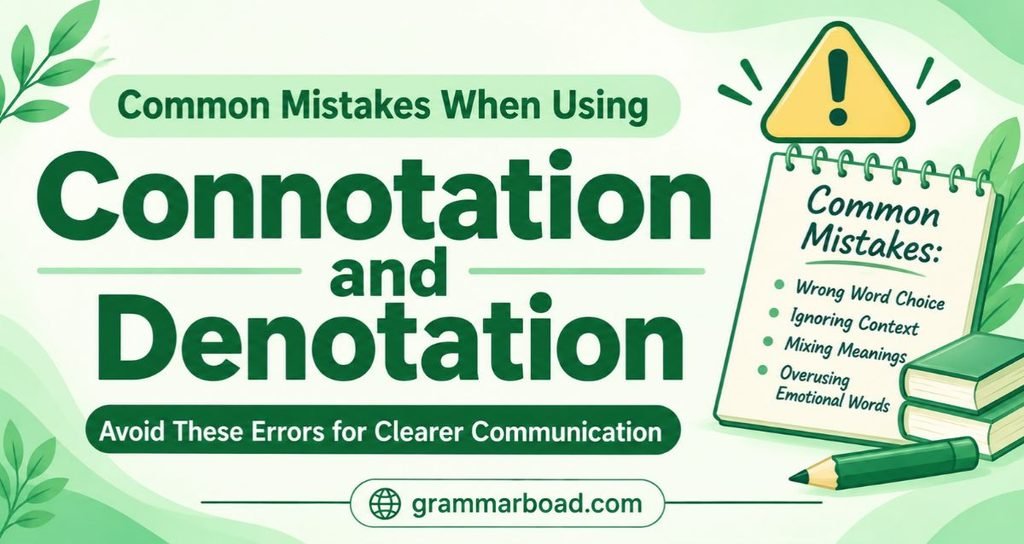
Many word-choice mistakes happen when writers overlook the difference between literal and suggested meanings. Here are some common errors to avoid:
- Treating synonyms as identical: Words such as slim and scrawny can describe similar body shapes, but their connotations are different.
- Ignoring audience and culture: A word that sounds positive in one community may have a negative association in another.
- Using emotionally loaded words in formal writing: This can make an objective report sound biased.
- Relying only on dictionary definitions: A definition may not explain whether a word sounds friendly, rude, formal, or old-fashioned.
- Confusing the two terms: Remember that denotation refers to literal meaning, while connotation refers to suggested or associated meaning.
Understanding these mistakes can help you make better vocabulary choices and communicate more effectively.
Learning Connotation vs Denotation helps writers avoid these common mistakes and select words that match their intended meaning, audience, and tone.
How to Identify Connotation in a Sentence
To identify connotation, look beyond a word’s literal meaning and consider the feelings or ideas it suggests.
Follow these simple steps:
- Read the sentence and identify its important descriptive words.
- Ask yourself what emotions or ideas each word suggests.
- Compare the word with a similar synonym. Notice whether the feeling changes.
- Decide whether the association is positive, negative, or neutral.
Example: The politician gave a bold speech.
The word bold suggests courage and confidence. If the sentence used reckless instead, it would create a more negative impression.
How to Identify Denotation in a Sentence
To identify denotation, focus on the basic dictionary meaning of a word rather than its emotional associations.
Follow these steps:
- Choose the word you want to examine.
- Ask yourself, “What is its plain, literal definition?”
- Ignore any feelings, symbols, or personal associations.
- Check a reliable dictionary if you need to confirm its meaning.
Example: The snake slid under the rock.
The denotation of snake in this sentence is simply a legless reptile. The sentence does not necessarily suggest danger or deceit.
FAQs
What Is the Main Difference Between Connotation and Denotation?
Denotation is a word’s literal, dictionary definition, while connotation is the emotional, cultural, or personal meaning it suggests beyond that definition.
Can a Word Have More Than One Connotation?
Yes. A word can suggest different ideas depending on its context, culture, and personal experiences. For example, the word wolf may suggest loyalty and family in one context but danger or aggression in another.
Is Connotation Always Positive or Negative?
No. Connotations can be positive, negative, or neutral. The association depends on the word, its context, and how people interpret it.
Which Is More Important, Connotation or Denotation?
Neither is more important in every situation. Denotation is essential when clarity and accuracy are needed, while connotation is important when tone, emotion, and persuasion matter.
Do Dictionaries Explain Connotation?
Some dictionaries include usage notes that describe a word’s tone, such as formal, informal, offensive, or humorous. However, many emotional and cultural associations are learned through reading and everyday communication.
How Can I Improve My Understanding of Connotation?
Read different types of writing, pay attention to how similar words create different impressions, and practice replacing words with synonyms to see how the tone of a sentence changes.
Conclusion
Understanding connotation vs denotation gives you greater control over language. Denotation provides the clear, literal meaning of a word, while connotation adds the emotions, tone, and associations that make language expressive. Both work together in almost every sentence you read or write.
When accuracy is important, focus on denotation. When you want to express feelings, persuade readers, or create vivid descriptions, consider connotation. By understanding both layers of meaning, you can choose words more carefully, write more clearly, and communicate more effectively with your readers.