You are typing a sentence about a wobbly table, a nervous voice, or a risky plan, and suddenly you pause. Is it shaky or shakey? This spelling question is common because both versions may look correct at first glance. However, only one is the standard English spelling. In this guide, you will learn the difference between shaky vs shakey, understand why people confuse them, and discover five easy tips to remember the correct spelling.
Quick Answer: Shaky or Shakey – Which Spelling Is Correct?
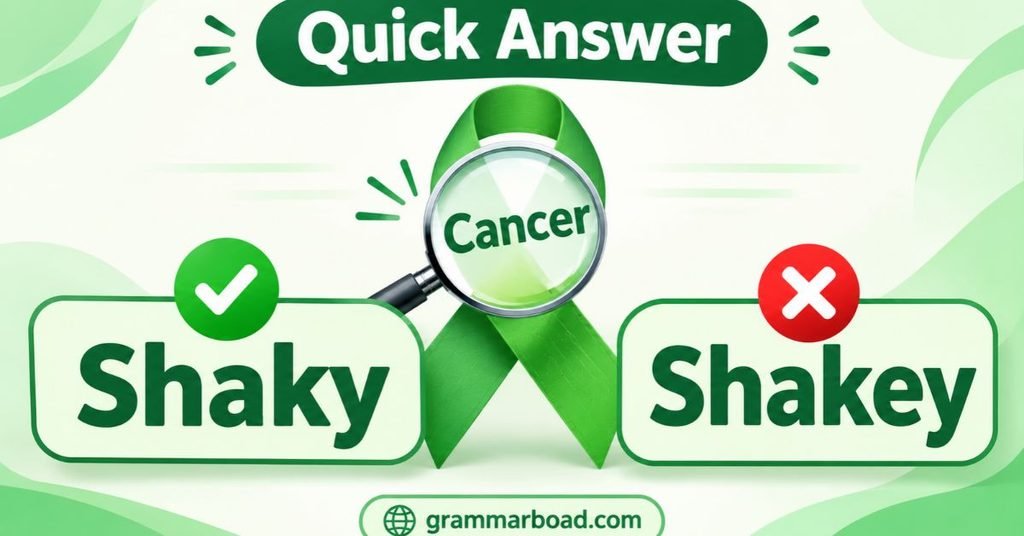
Shaky is the correct standard English spelling. It is used in both American and British English. When comparing Shaky vs Shakey, remember that only “shaky” is the standard spelling of the adjective.
Shakey is not a standard spelling of the adjective. It may appear in proper nouns, such as personal nicknames or brand names, but it should not be used in ordinary sentences.
- Correct: The ladder felt shaky under his feet.
- Incorrect: The ladder felt shakey under his feet.
Remember that when you want to describe something unsteady, trembling, or unreliable, always use shaky.
What Is the Difference Between Shaky and Shakey?
The main difference between shaky and shakey is spelling. When comparing Shaky vs Shakey, remember that shaky is the accepted English adjective, while shakey is a nonstandard spelling when used with the same meaning.
| Spelling | Status | Where You’ll See It |
|---|---|---|
| Shaky | Correct | Everyday writing, books, news, and academic work |
| Shakey | Nonstandard | Personal names, brands, nicknames, or spelling mistakes |
Unlike words such as catalog and catalogue, these two spellings are not regional alternatives. Whether you are writing in American or British English, shaky is the correct choice.
What Does Shaky Mean?
Shaky is an adjective that describes something trembling, unsteady, unstable, or unreliable. When understanding Shaky vs Shakey, it is important to remember that shaky is the correct standard spelling. It can refer to physical movement as well as situations, ideas, and feelings.
For example:
- The old bridge looked shaky after the storm.
- Her hands were shaky before the interview.
- The company is facing a shaky financial situation.
- His explanation sounded shaky because he lacked evidence.
In simple terms, something is shaky when it is not steady, secure, or reliable. Using the correct spelling of shaky helps make your writing clear and accurate..
What Are the Different Meanings of Shaky?
Although shaky is commonly associated with physical movement, understanding Shaky vs Shakey also means knowing the different meanings of the correct spelling, shaky, depending on the context.
- Physically unsteady: Something that moves or wobbles instead of remaining firm, such as a shaky chair or ladder.
- Trembling: A physical movement caused by fear, nervousness, weakness, or illness, such as shaky hands or a shaky voice.
- Unreliable: Something that lacks strong support or evidence, such as a shaky argument or explanation.
- Uncertain or unstable: A situation that may change or fail, such as a shaky economy or friendship.
- Lacking confidence or skill: Someone who is not completely comfortable or confident with a particular ability, such as saying, “My French is a little shaky.”
These meanings show that shaky can describe physical objects, emotions, abilities, and uncertain situations. Remember that shaky is the correct standard spelling in both American and British English.
How Do You Pronounce Shaky?
The word shaky is pronounced SHAY-kee (/ˈʃeɪki/). Understanding its pronunciation can also help clarify the spelling difference in Shaky vs Shakey.
It has two syllables:
- Shay: The first syllable rhymes with “day.”
- Ky: The second syllable sounds like “key.”
The pronunciation may contribute to the spelling confusion. Some people hear the ending and mistakenly think the word needs an extra letter. However, the correct spelling remains shaky, regardless of how it sounds. Both American and British English use this standard spelling.
Why Do People Write Shakey Instead of Shaky?
Many people write shakey because the spelling looks familiar or seems to follow common English spelling patterns. Here are some reasons behind this mistake:
- Confusion with the word “shake”: Since shake ends with a silent “e,” some writers mistakenly keep that letter when forming the adjective.
- Similar spelling patterns: Words such as pricey, dicey, and cagey contain an “e” before the final “y,” which can confuse learners.
- Influence of names and brands: Seeing Shakey used as a nickname or business name can make the spelling appear correct in ordinary writing.
- Typing mistakes: People sometimes add an unnecessary letter while typing quickly on a phone or computer.
Understanding these reasons can help you avoid the mistake in everyday writing.
Is Shakey Ever Correct?
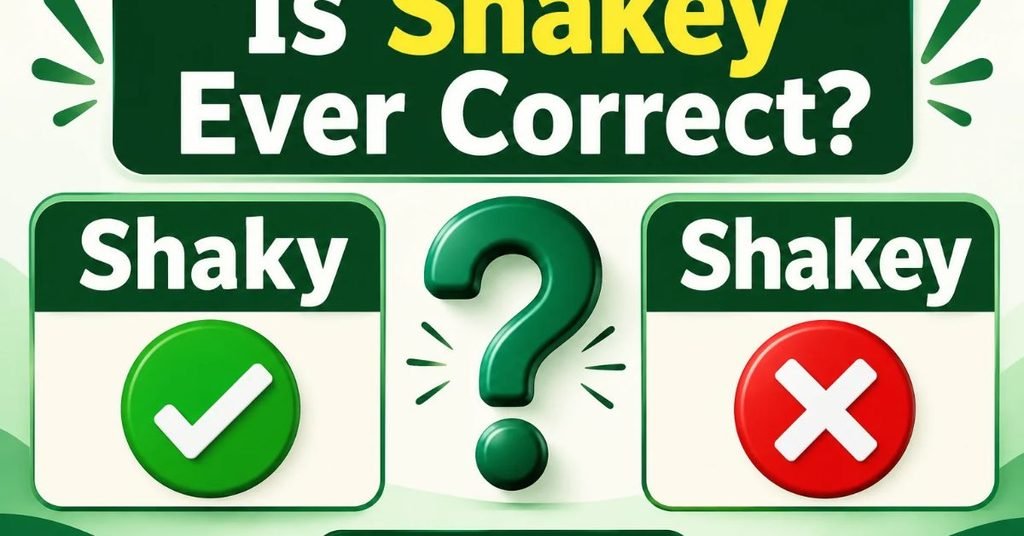
Yes, Shakey can be correct when it is used as a proper noun, such as a person’s nickname, business name, or brand name.
However, it is not an accepted alternative spelling of the adjective shaky.
For example:
- Correct: The old wooden chair looks shaky.
- Correct: We ordered pizza from Shakey’s.
- Incorrect: The old wooden chair looks shakey.
The important thing is to understand the context. Use Shakey only when it is the established spelling of a specific name, and use shaky when describing something unstable or unsteady.
Can Shakey Be Used as a Name?
Yes. Proper nouns follow their own spelling conventions, so Shakey can be used as a personal nickname or part of a business name. This is an important distinction when understanding Shaky vs Shakey because Shakey may be correct as a name, even though it is not the standard spelling of the adjective.
A well-known example is Shakey’s Pizza, a restaurant chain whose name is associated with its founder’s nickname.
When writing about a person, company, or brand that uses this spelling, always reproduce the name exactly as it is officially written.
Examples:
- We ordered a large pizza from Shakey’s.
- The table was shaky, so we moved it.
- Shakey is the nickname used by the person.
Remember, use Shakey for an established proper name and shaky when describing something unsteady, trembling, or unreliable.These examples show why context matters when deciding between the two spellings.
What Are the Synonyms and Antonyms of Shaky?
Learning synonyms and antonyms can help you understand the meaning of shaky and use it more effectively in different sentences.
Synonyms of Shaky
- Unsteady
- Wobbly
- Trembling
- Unstable
- Rickety
- Precarious
- Tremulous
- Unreliable
Antonyms of Shaky
- Steady
- Stable
- Firm
- Solid
- Secure
- Reliable
- Confident
- Strong
Choose a synonym according to the context. For example, wobbly works well for a physical object, while unreliable is more suitable for an argument or a plan.
Word Origin (Etymology) of Shaky
The word shaky comes from the verb shake, which has roots in Old English. The adjective is formed by adding the suffix -y, which commonly means “characterized by” or “having the quality of.”
For example:
- Dust + y = Dusty
- Wind + y = Windy
- Sleep + y = Sleepy
- Shake – e + y = Shaky
When the suffix -y is added to shake, the final silent “e” is dropped. This gives us the correct spelling: shaky.
Understanding this word formation makes the spelling easier to remember.
How Is Shaky Used in Different Contexts?
The word shaky can be used in everyday conversations, professional writing, and many other situations.
Here are some common examples:
- Everyday life: “The shelf is a little shaky, so don’t put anything heavy on it.”
- Health and emotions: “He felt shaky after skipping breakfast.”
- Business and finance: “The company’s shaky finances worried investors.”
- Sports: “The team had a shaky first half but recovered after the break.”
- Photography and video: “The shaky footage was difficult to watch.”
- Arguments and ideas: “The theory rests on shaky assumptions.”
These examples demonstrate how one adjective can describe different types of instability and uncertainty.
Real-Life Examples of Shaky in Sentences
Here are seven practical sentences that show how to use shaky correctly:
- The wooden bridge was so shaky that we crossed it one at a time.
- Her voice became shaky as she started her speech.
- He gave a shaky answer because he had not prepared.
- After the long flight, I felt tired and a little shaky.
- Their business partnership got off to a shaky start.
- The tripod was shaky, which made the photograph blurry.
- My memory of that day is shaky at best.
Notice how shaky describes physical movement, emotions, confidence, and uncertain situations in these examples.
Common Spelling Mistakes People Make
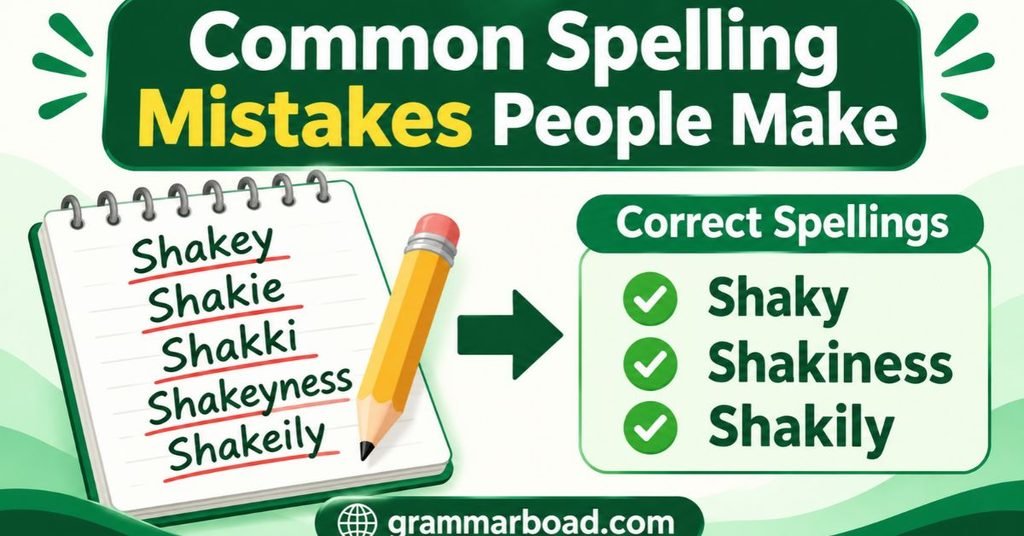
Writers sometimes make additional spelling mistakes when using shaky and its related forms. Understanding Shaky vs Shakey can help you recognize these common errors and use the correct spellings.
Here are some common errors and their correct versions:
- Shakey → Shaky
- Shakie → Shaky
- Shakki → Shaky
- Shakyness → Shakiness
- Shakeyness → Shakiness
- Shakeily → Shakily
It is also useful to remember the related word forms:
- Adjective: Shaky
- Noun: Shakiness
- Adverb: Shakily
For example, you can write, “His hands were shaky,” or “He stood up shakily.”
Remembering these related forms will help you avoid spelling mistakes in different types of sentences.of sentences.
Shaky vs Shakey: Examples of Correct and Incorrect Usage
The following examples make the spelling difference easier to understand.
| Incorrect Spelling | Correct Spelling |
| The chair is shakey. | The chair is shaky. |
| He sounded shakey on the phone. | He sounded shaky on the phone. |
| It was a shakey start. | It was a shaky start. |
| She spoke shakeyly. | She spoke shakily. |
| Their plan is on shakey ground. | Their plan is on shaky ground. |
Always remember that shaky is the correct adjective, while shakily is its correct adverb form.
5 Easy Tips to Remember the Correct Spelling
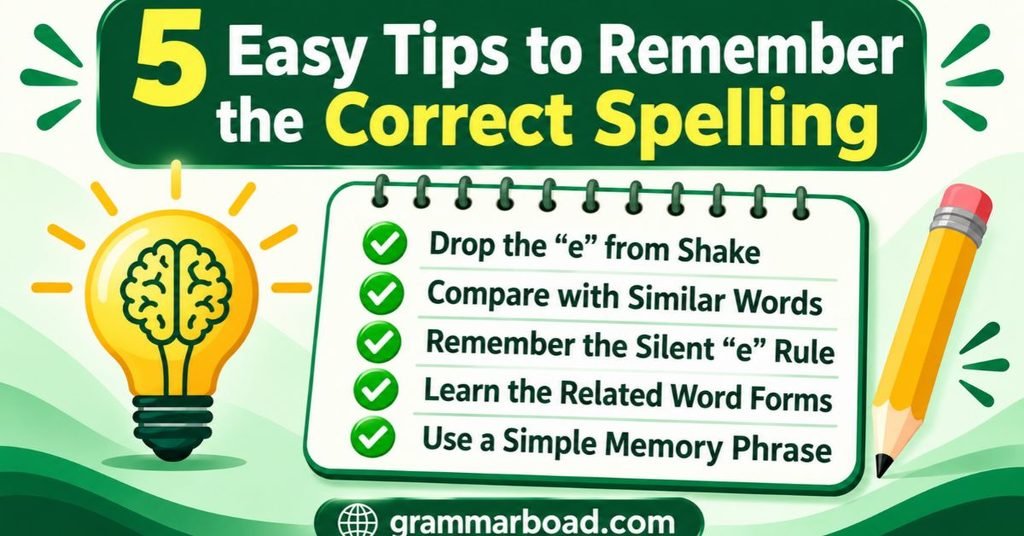
Here are five simple tips to help you remember how to spell shaky correctly.
1. Drop the “e” from Shake
Start with the verb shake and remove its final silent “e” before adding the suffix “-y.” This gives you shaky. You can remember a similar pattern in words such as smoke and smoky.
2. Compare It with Similar Words
Think about other English words that follow a similar spelling pattern:
- Bone → Bony
- Stone → Stony
- Ice → Icy
- Noise → Noisy
These examples can help you remember that shake becomes shaky.
3. Remember the Silent “e” Rule
In many English words, the final silent “e” is dropped before adding a suffix that begins with a vowel. This is why shake becomes shaky when “-y” is added.
4. Learn the Related Word Forms
Remember the three related forms: shaky, shakiness, and shakily. Learning these words together can help you recognize the correct spelling more easily.
5. Use a Simple Memory Phrase
Try remembering this sentence: “A shaky word needs no extra letter.”
This simple phrase reminds you that shaky does not need an additional “e” before the final “y.”
Also Read This:https://grammarboad.com/of-course-or-ofcourse/
Why Correct Spelling Matters in Everyday Writing
Correct spelling plays an important role in clear and professional communication. Whether you are writing emails, school assignments, résumés, or website articles, spelling mistakes can make your work look less polished.
Using the correct spelling also helps readers understand your message without confusion. Even a small mistake, such as writing shakey instead of shaky, can affect the overall quality of your writing.
Developing good spelling habits improves your confidence and makes your communication more effective. Taking a few seconds to check a word can make a noticeable difference in your writing.
FAQs
1. Is it shaky or shakey?
When comparing Shaky vs Shakey, shaky is the correct standard English spelling. Shakey is not a standard spelling of the adjective.
2. Is shakey a real word?
Shakey can appear as a proper name or brand name, but it is not a standard English adjective meaning unsteady or unreliable.
3. Why does shaky drop the “e” from shake?
The final silent “e” in shake is dropped when the suffix “-y” is added, forming the adjective shaky.
4. What is the noun form of shaky?
The noun form is shakiness. For example: “The shakiness of his voice was obvious.”
5. What is the adverb form of shaky?
The adverb form is shakily. For example: “She stood up shakily after sitting for several hours.”
6. Can I use shakey in a name?
Yes. You can use Shakey if it is the established spelling of a person’s nickname, company, or brand name.
7. Is there a British and American spelling difference?
No. Both American and British English use shaky as the standard spelling.
Conclusion
The answer to shaky vs shakey is simple: shaky is the correct spelling in standard English. It comes from the verb shake, which drops its final silent “e” when the suffix “-y” is added. The spelling shakey is not an accepted alternative for the adjective, although it can appear in personal names and brand names, such as Shakey’s Pizza.
By remembering the simple spelling rule, learning related word forms, and practicing with everyday examples, you can avoid this common mistake. Whenever you describe something unsteady, trembling, or unreliable, choose shaky and write with confidence.