Few words trip up writers as often as “successful.” It appears in résumés, emails, social media posts, and school essays, yet it is often typed with one letter missing. If you have ever wondered whether the correct spelling is successful vs succesful, the answer is simple. However, understanding why one spelling is correct will help you avoid this mistake in the future.
Quick Answer
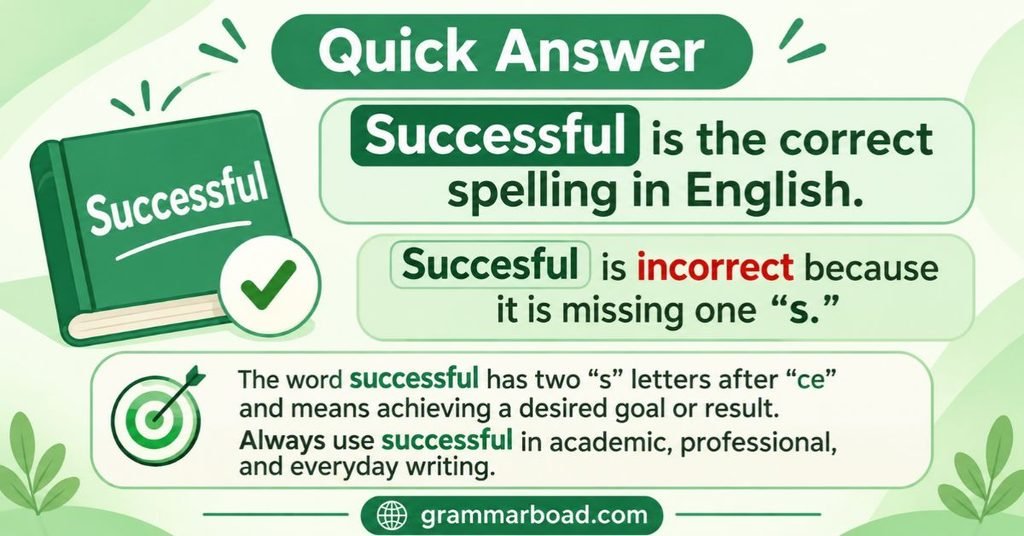
Successful is the only correct spelling. Succesful is a misspelling because it leaves out one “s.” The correct word contains a double “c” and a double “s” in the middle: suc-cess-ful.
Understanding Successful vs Succesful helps you remember the correct spelling and avoid common English spelling mistakes.
Knowing the difference between Successful vs Succesful helps you avoid this common spelling mistake in everyday and professional writing.
What Does “Successful” Mean?
“Successful” is an adjective. It describes someone or something that achieves a goal, produces a favorable result, or reaches a desired outcome. It can also describe a person who has gained wealth, recognition, or respect in their field.
The difference between Successful vs Succesful is simple: successful is the correct spelling, while succesful is a misspelling.
Here are a few examples:
- A successful product launch
- A successful career in medicine
- A successful attempt to fix a problem
In each example, the word describes a positive result or achievement.
Why Is “Succesful” Incorrect?
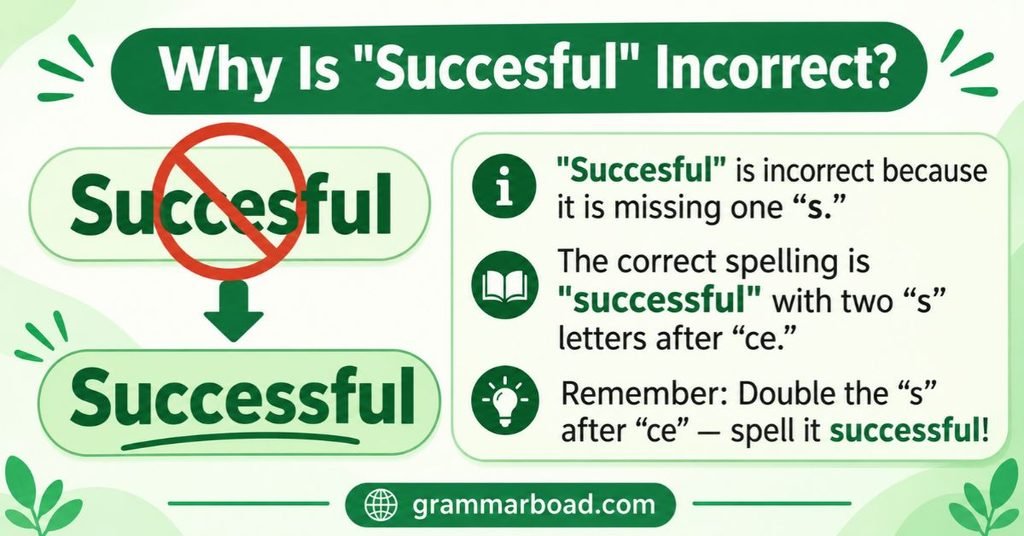
“Succesful” is incorrect because it leaves out one of the letters in the base word “success.” The correct spelling, “successful,” is formed by adding the suffix -ful to the noun success.
Since “success” ends with two “s” letters, both remain when the suffix is added. Dropping one “s” creates “succesful,” which is not an accepted standard English spelling.
Spell-checking tools will usually flag this error, but it is still useful to learn the correct spelling instead of relying entirely on automatic corrections.
Why Is “Successful” Spelled with Two C’s and Two S’s?
The word “successful” contains a double “c” and a double “s.” Both letter pairs are part of its correct spelling.
The double “c” and double “s” come from the base word “success.” When you add the suffix -ful, the spelling of the base word stays the same.
Written letter by letter, the word is:
s-u-c-c-e-s-s-f-u-l
There are three “s” letters in total: one at the beginning and two together in the middle. This is why writers sometimes miss a letter when typing the word.
A simple way to remember the pattern is: cc + ess + ful.
What Is the Difference Between Successful and Success?
The words “success” and “successful” are closely related, but they have different grammatical roles.
| Word | Part of Speech | Example |
| Success | Noun | Her hard work led to success. |
| Successful | Adjective | She is a successful writer. |
“Success” names an achievement or favorable result. “Successful” describes a person, plan, or result that achieves a goal.
Understanding this word relationship also makes the correct spelling easier to remember.
Why This Mistake Matters in Real Life
A single missing letter may seem minor, but spelling errors can affect how readers perceive your writing. A typo in a job application, business email, or client proposal can make your work look rushed, even when the content is strong.
Because “successful” is often used to describe achievements and professional accomplishments, it frequently appears in résumés, LinkedIn profiles, cover letters, and company websites.
Using the correct spelling helps your writing look polished, clear, and professional.
Successful vs Succesful: Comparison
| Feature | Successful | Succesful |
| Correct spelling | Yes | No |
| Double “c” | Yes | Yes |
| Double “s” | Yes | No |
| Found in standard dictionaries | Yes | No |
| Use in standard writing | Correct | Incorrect |
The main difference is the missing “s” in “succesful.” Although the two forms may look similar, only “successful” is accepted in standard English.
When comparing Successful vs Succesful, always remember that successful is the accepted spelling in both British and American English.
British English vs American English
Many English words have different spellings in British and American English. Examples include “colour” and “color” or “centre” and “center.”
However, “successful” is not one of these words. Both British and American English use the same spelling.
Therefore, you should write successful regardless of whether your audience is in the United States, the United Kingdom, Australia, or another English-speaking country.
Is “Successful” a Noun, Verb, or Adjective?
“Successful” is an adjective. It describes a person, action, plan, or result that achieves a desired outcome. It does not function as a noun or verb on its own.
Here is how its related word forms work:
- Success is the noun.
- Succeed is the verb.
- Successful is the adjective.
- Successfully is the adverb.
Examples:
- Noun: Their success surprised everyone.
- Verb: They hope to succeed this year.
- Adjective: It was a successful experiment.
- Adverb: She successfully completed the course.
Knowing these word forms can help you use each one correctly in a sentence.
Common Misspellings Related to “Successful”
Besides “succesful,” writers sometimes make other spelling errors. Here are some common incorrect forms and their correct versions:
| Incorrect | Correct |
| Succesful | Successful |
| Sucessful | Successful |
| Successfull | Successful |
| Succesfull | Successful |
| Sucessfull | Successful |
These mistakes usually happen when writers leave out one of the repeated letters or add an extra “l” at the end.
Remember that the suffix -ful always has one “l.” Although the separate word “full” has two “l” letters, the suffix does not.
How to Remember the Correct Spelling
Here are five easy tips to help you remember the correct spelling:
- Start with “success.” If you can spell “success” correctly, simply add “ful.”
- Remember “cc” followed by “ss.” Picture the doubled letters in this order: double C, then double S.
- Use a mnemonic. Try this phrase: “Two Cs, two Ss, then FUL for success.”
- Break it into syllables. Divide the word into three parts: suc-cess-ful. This can help you remember its spelling.
- Remember that “-ful” has one L. The suffix is always written with a single “l,” not two.
These five tips can help you remember Successful vs Succesful and use the correct spelling confidently in your everyday writing.Practicing these tips can make the correct spelling easier to recall whenever you write.
These five tips can help you remember Successful vs Succesful and use the correct spelling confidently in your everyday writing.
Examples of “Successful” in Everyday Sentences
Here are some examples showing how to use “successful” correctly:
- The team made a successful comeback in the final minutes.
- She runs a successful bakery on the corner.
- After three attempts, the repair was finally successful.
- He gave a successful presentation to the board.
- Our fundraiser was more successful than we expected.
These examples show how the adjective can describe achievements, events, and positive outcomes.
Real-Life Examples
The word “successful” is commonly used in different situations, including work, education, business, and everyday conversations.
- At work: “I led a successful campaign that increased customer engagement.”
- In school: “A successful essay starts with a clear thesis.”
- In daily life: “We had a successful trip, and everything went smoothly.”
- In business writing: “The company celebrated the successful completion of its new project.”
In each example, the word describes something that achieved a positive result.
Words Related to “Successful”
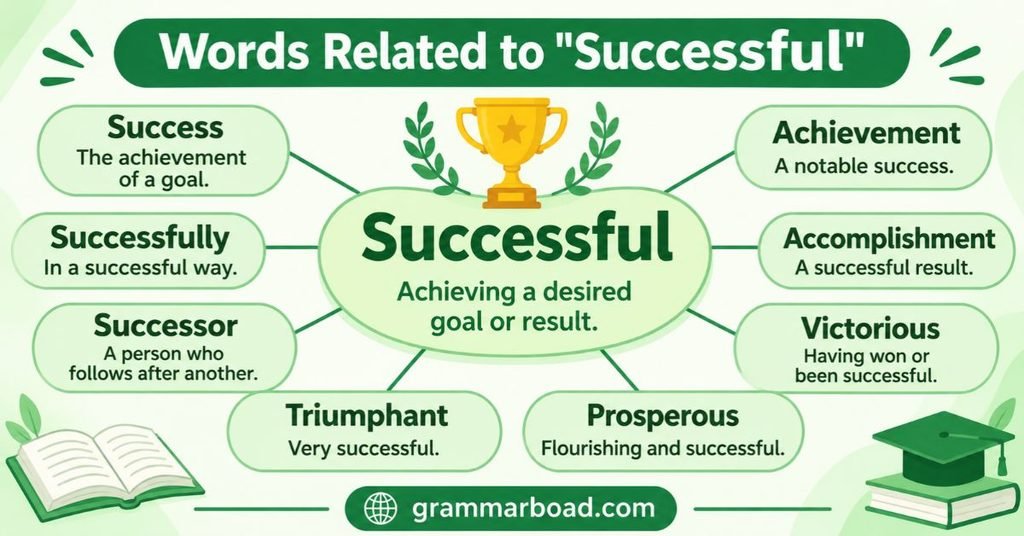
Understanding related words can make the spelling and meaning of “successful” easier to remember.
- Success (noun): The achievement of a goal.
- Succeed (verb): To achieve a desired outcome.
- Successfully (adverb): In a way that achieves a goal.
- Unsuccessful (adjective): Not achieving a desired result.
- Successive (adjective): Following one after another.
- Succession (noun): A sequence of people or events.
- Successor (noun): Someone who follows another person in a position or role.
Learning these related words can help you recognize common spelling patterns and understand how words in the same family are connected.
Common Mistakes to Avoid
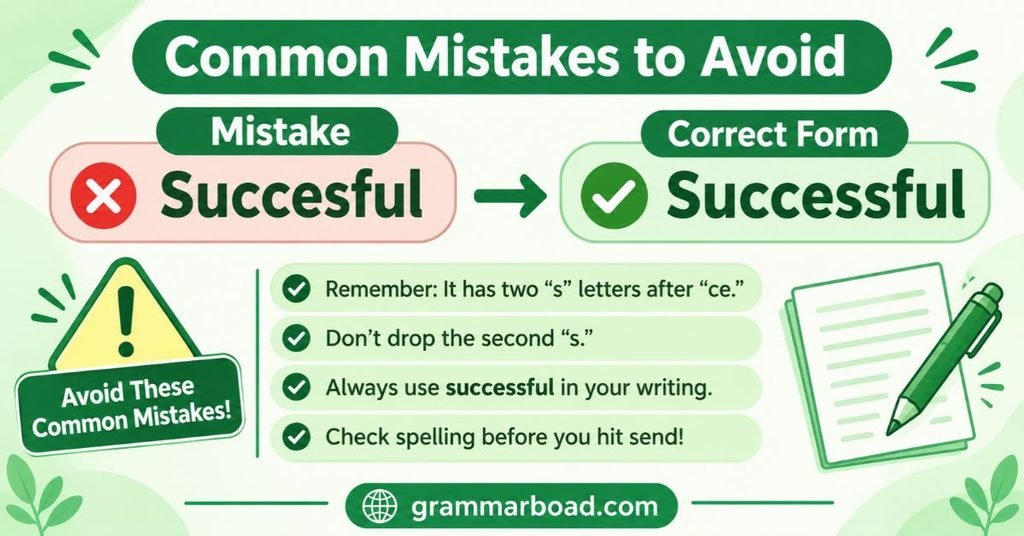
Writers often make a few common mistakes when using “successful.” Here are some errors to watch out for:
- Dropping the second “s”: Writing “succesful” instead of “successful.”
- Adding an extra “l”: Writing “successfull” instead of “successful.”
- Dropping one “c”: Writing “sucessful” instead of “successful.”
- Relying only on spell-checking tools: Automatic tools can sometimes miss errors or make incorrect suggestions.
- Confusing related word forms: Using “success” instead of “successful” in a sentence such as “She is a success writer.” The correct sentence is “She is a successful writer.”
Checking these common mistakes can help you improve your spelling and avoid errors in professional and everyday writing.
Also Read This:https://grammarboad.com/writing-or-writting/
Tips for Improving Your English Spelling
Improving your spelling takes practice, but a few simple habits can make a noticeable difference.
- Read regularly: Reading books, articles, and other content helps you recognize correct spelling in context.
- Learn word families: Once you know “success,” related words such as “successful” and “successfully” become easier to remember.
- Keep a personal spelling list: Write down words you often misspell and review them regularly.
- Proofread carefully: Read your writing slowly to catch missing or repeated letters.
- Break words into parts: Identify the root word, suffix, and any repeated letters.
- Use a trusted dictionary: Check unfamiliar words instead of guessing their spelling.
With regular practice, you can become more confident in your English spelling.
FAQs
1. Is “succesful” ever correct?
No. “Succesful” is always considered a misspelling in standard English. The correct form is “successful.”
2. How many S’s are in “successful”?
There are three “s” letters in total: one at the beginning of the word and a double “s” in the middle.
3. How many C’s are in “successful”?
There are two “c” letters, written together as “cc.”
4. Is “successful” spelled differently in British English?
No. British and American English use the same spelling: “successful.”
5. What is the opposite of “successful”?
The most common opposite is “unsuccessful.” Depending on the context, words such as “failed” or “fruitless” may also be suitable.
6. Why do people spell it “successfull”?
Many writers confuse the suffix “-ful” with the separate word “full.” The suffix “-ful” always has only one “l,” so the correct spelling is “successful.”
Conclusion
When it comes to successful vs succesful, only one spelling is correct: successful. The word is formed from “success” and the suffix “-ful,” so it keeps the double “c” and double “s” from its base word and ends with a single “l.”
Remember the five spelling tips in this guide, practice using the word in sentences, and check your writing before publishing or sending it. Whether you are writing a quick message, a school assignment, or an important professional document, using “successful” correctly will help make your English clearer and more polished.






2 thoughts on “Successful vs Succesful: 5 Easy Spelling Tips”