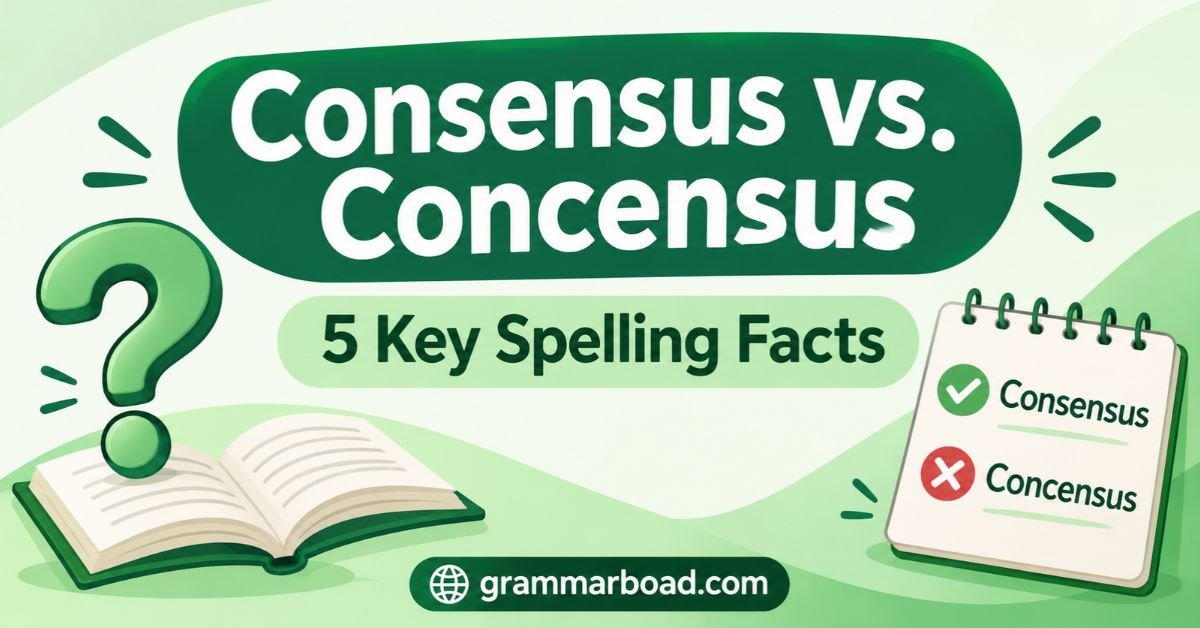
If you have ever paused mid-sentence wondering whether the word is spelled “consensus” or “concensus,” you are far from alone. The two look almost identical, and the wrong one slips into emails, reports, and essays more often than you might expect. When comparing Consensus vs. Concensus, the short answer is simple: consensus is the only correct spelling, while “concensus” is a common misspelling.
This guide to Consensus vs. Concensus explains why one spelling is correct, shows you how to use the word properly, and shares simple tricks to help you remember the correct spelling every time.
Consensus vs Concensus: The Quick Answer
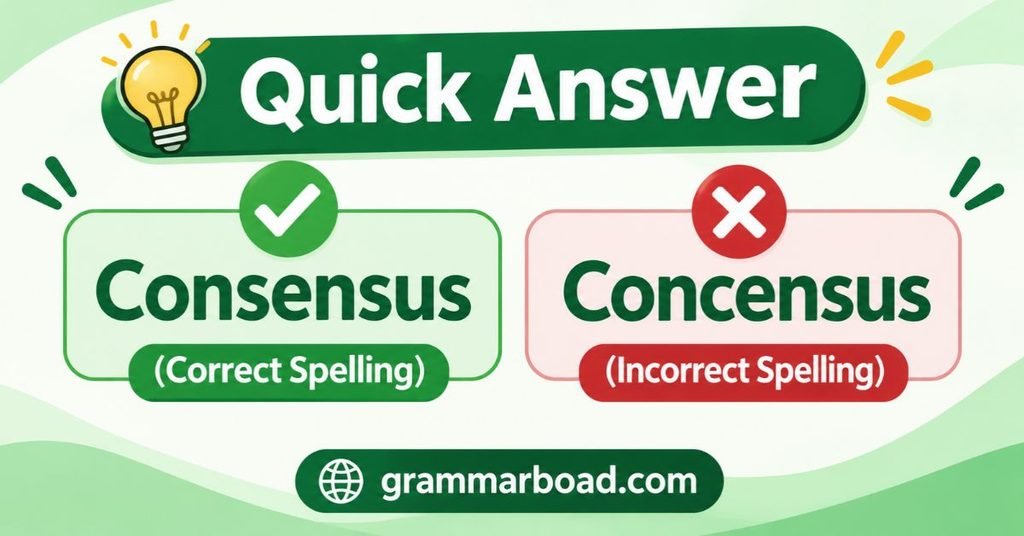
When comparing Consensus vs. Concensus, remember that consensus is correct, while concensus is incorrect and does not appear in standard dictionaries.
The word is spelled with an s in the middle: con-sen-sus. If you remember that it contains “sen” and “sus,” not “cen,” you can easily avoid this common spelling mistake.
What Does Consensus Mean?
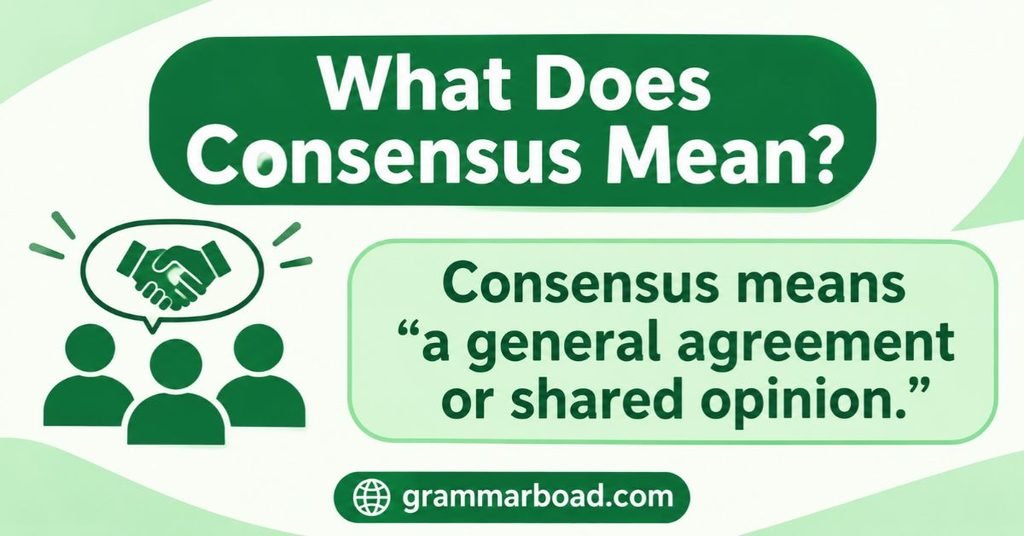
When understanding Consensus vs. Concensus, it is important to know that consensus means a general agreement reached by a group of people. It describes a shared opinion or decision that most or all members of a group support.
For example, a team might reach a consensus on a project deadline after discussing it together. A group of scientists might share a consensus about a particular finding. In both cases, the word points to common ground among many people.
Why Is Concensus Incorrect?
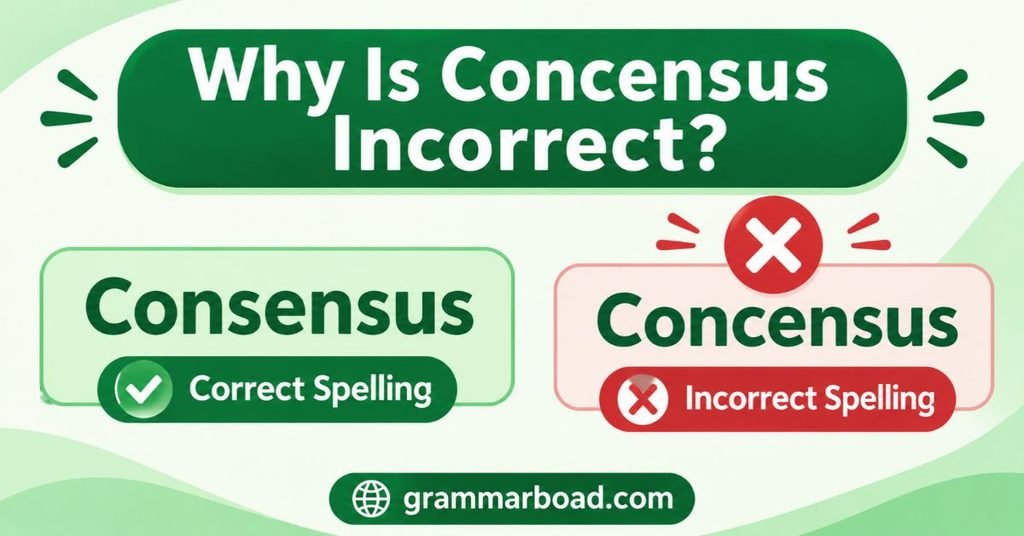
When comparing Consensus vs. Concensus, it is important to understand why “concensus” is incorrect. The correct spelling, consensus, comes from the Latin consentire, meaning “to feel together” or “to agree.” That root is also behind the English word consent.
Since “consent” and “consensus” share the same origin, both are spelled with sen, not “cen.” Writing “concensus” breaks that connection and produces a word that simply does not exist in English.
Consensus vs Concensus in a Sentence
Seeing Consensus vs. Concensus in context makes the spelling difference clear.
Correct:
- The committee reached a consensus after a long meeting.
- There is no consensus among experts on this issue.
Incorrect:
- The committee reached a concensus after a long meeting.
- There is no concensus among experts on this issue.
Only the first version of each pair is acceptable in professional or academic writing.writing.
How Do You Pronounce Consensus?
Consensus is pronounced kuhn-SEN-sus. The stress falls on the second syllable.
Because the middle of the word is pronounced with a clear “sen” sound, some writers hear a soft “c” there and mistakenly write “concensus.” This is one reason the error is so common.
Consensus Meaning in Simple English
When learning Consensus vs. Concensus, remember that consensus simply means everyone mostly agrees. If a group reaches a consensus, they have found an answer or decision that most of them accept.
Think of friends choosing a restaurant. After some back-and-forth, they settle on a place that works for the whole group. That shared decision is an example of consensus.
Consensus Does Not Always Mean Complete Agreement
When comparing Consensus vs. Concensus, remember that consensus does not require every single person to agree. In practice, that is not always the case.
A consensus often means the majority of the group supports an idea, or that everyone is willing to accept a decision even if it is not their first choice. Some members may have reservations, yet the group still moves forward together.
So when you read that “there is a consensus,” it usually signals broad support, not necessarily perfect unanimity.
What Is the Difference Between Consensus and Agreement?
The two words are related but not identical.
| Term | Meaning | Typical Use |
| Agreement | Two or more people hold the same view or make a deal | Personal, contractual, or one-to-one situations |
| Consensus | A general agreement across a group | Group decisions, expert opinions, public opinion |
You can have an agreement between two people. A consensus, however, implies a wider group arriving at a shared position.
Common Phrases With Consensus
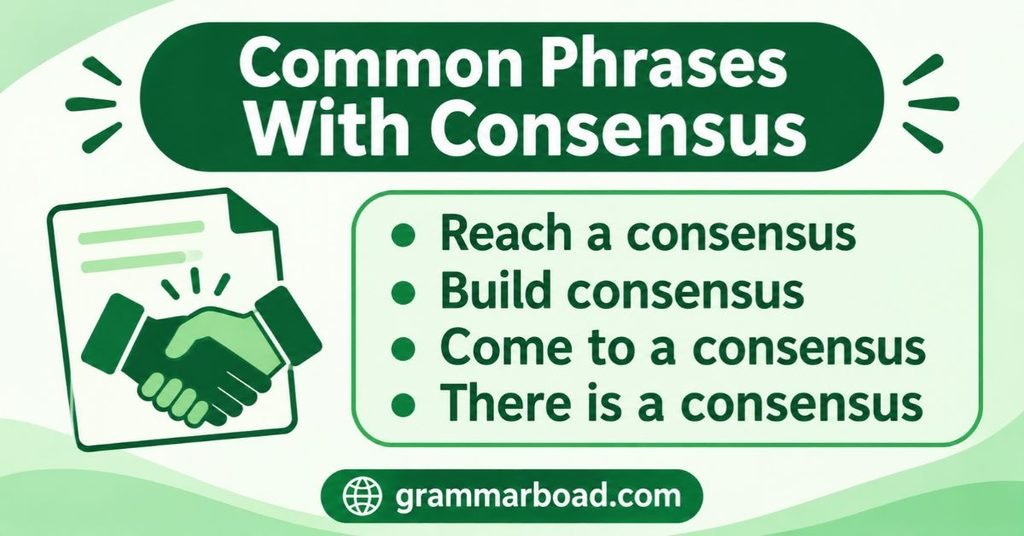
When learning Consensus vs. Concensus, it is also helpful to understand common expressions that use the correct spelling, consensus:
- Reach a consensus: to come to a shared decision
- Build consensus: to work toward agreement among a group
- General consensus: broad agreement among most people
- Broad consensus: wide support across a group
- Scientific consensus: the shared position of experts in a field
- Consensus opinion: the view held by most members of a group
- Lack of consensus: no shared agreement
One note on style: “general consensus” is very common, though some editors consider it redundant because consensus already implies general agreement. It is not wrong, but “consensus” alone is often cleaner.h some editors consider it redundant since consensus already implies general agreement. It is not wrong, but “consensus” alone is often cleaner.
Is Consensus a Noun or a Verb?
Consensus is a noun. It is not a verb, and it does not have a verb form in standard English.
You can say, “We reached a consensus,” but you cannot say, “We consensused on the plan.” If you need an action word, use phrases like “reach a consensus,” “agree,” or “come to an agreement.”
Consensus in American English
In American English, consensus is spelled exactly the same way: consensus. There is no alternate British or American spelling variation, so you do not need to adjust it depending on your audience.
This is helpful to know if you write for international readers. Whether your audience is in the United States, the United Kingdom, Canada, or Australia, the correct spelling remains consistent.
Why Do People Spell Consensus as Concensus?
Several common reasons explain the mistake:
- Sound confusion: The “s” and soft “c” can sound alike, so the ear can mislead the spelling.
- Pattern influence: Many English words contain a “c” after the “con-” prefix, which nudges writers toward “concensus.”
- Visual similarity: The two spellings look nearly the same at a glance, making the error easy to miss when proofreading.
- Autopilot typing: Fast typing often leads to repeating a familiar letter pattern.
Understanding why the error happens makes it easier to catch.
When Should You Use the Word Consensus?
Use consensus when you want to describe shared agreement within a group. It fits well in:
- Business meetings and team decisions
- News reporting and public opinion discussions
- Academic or scientific writing
- Policy and political discussions
- Everyday conversation about group choices
Avoid using it when only two people are involved or when you are describing a legal agreement. In those cases, “agreement” or “contract” is usually the better choice.
Easy Memory Tricks for Consensus
Here are a few quick ways to lock in the correct spelling:
- Think of consent. Consensus and consent share the same root, so both contain “sen.”
- Remember the “census” link. The ending of consensus, -ensus, matches the middle and end of census. If you can spell “census,” the back half of consensus will feel familiar.
- Break it into chunks. Say it as con-SEN-sus.
- Count the letters. Consensus has three s letters and only one c, at the very start. If you find yourself typing a second c, stop and double-check.
Consensus vs Concensus: Common Writing Mistakes
Beyond the main misspelling, writers sometimes stumble in these ways:
- Writing “concensus” instead of “consensus.” The most frequent error.
- Using “consensus of opinion.” This is redundant, since consensus already means shared opinion.
- Using “consensus” as a verb. It is a noun only.
- Confusing it with “census.” A census is an official count of a population, which is a completely different concept.
- Assuming it always means unanimity. As covered above, it does not.
Examples of Consensus in Everyday Writing
Here are natural examples across different contexts:
- Workplace: “The marketing team reached a consensus on the new campaign theme.”
- Family: “After some debate, we came to a consensus about where to go on vacation.”
- News: “There is a growing consensus that the new policy needs revision.”
- Academic: “Researchers have yet to establish a consensus on the best teaching method.”
- Casual: “The consensus in our group chat is that pizza wins.”
Each sentence uses the word correctly and shows how it fits into different tones.
How to Correct the Mistake Automatically
If you tend to type “concensus,” a few simple habits can fix it:
- Use spell check. Most word processors flag “concensus” immediately and suggest the correct form.
- Enable autocorrect. Add “concensus” to your autocorrect list so it replaces itself with “consensus” as you type.
- Search and replace. Before publishing, run a find-and-replace for “concensus” in your document.
- Proofread aloud. Reading slowly makes the misspelling easier to catch.
These small steps save time and keep your writing polished.
Consensus vs Concensus: A Quick Comparison
| Feature | Consensus | Concensus |
| Correct spelling? | Yes | No |
| In dictionaries? | Yes | No |
| Part of speech | Noun | Not a real word |
| Meaning | General agreement among a group | None |
| Root | Latin consentire (to agree) | None |
| Safe for professional use? | Yes | No |
Also Read This:https://grammarboad.com/colon-vs-semicolon/
FAQs
Is it “consensus” or “concensus”? The correct spelling is consensus. “Concensus” is always a misspelling.
How many s’s are in consensus? Three: con-sen-su-s. There is only one c, at the start of the word.
Is “consensus” a noun? Yes. It is a noun meaning general agreement within a group.
What is the difference between consensus and census? A census is an official count of a population. Consensus is general agreement among a group. They look somewhat similar but have different meanings.
Is “general consensus” correct? It is widely used and understood, though some writers prefer just “consensus” to avoid repeating the idea of general agreement.
Does consensus mean everyone must agree? Not necessarily. It usually means broad agreement or acceptance, even if a few people have reservations.
Is there a British spelling of consensus? No. The spelling is the same in American and British English.
Conclusion
The takeaway is simple: consensus is correct, and concensus is not. Remember that the word shares its roots with “consent,” echoes the ending of “census,” and is spelled with an s where many people mistakenly place a c.
Keep it in mind as a noun meaning general agreement among a group, and use it confidently whenever you are describing shared decisions or opinions. With a few memory tricks and a quick proofread, you will never second-guess this spelling again.