You may have come across the word smaragdine in an old novel, a poem, or a description of a jewel and wondered what it means. It is a rare, elegant adjective that means emerald-green or relating to emeralds. This guide explains the smaragdine meaning, its origin, pronunciation, and usage, with clear examples to help you understand and use the word correctly.
Smaragdine Meaning – Quick Answer
Smaragdine is an adjective meaning of or relating to emeralds, or having the green color of an emerald. It is a rare, literary word that appears mainly in descriptive, poetic, and historical writing.
Example: “The lake shimmered with a smaragdine glow beneath the afternoon sun.”
What Does Smaragdine Mean?
Smaragdine describes something that resembles an emerald, usually in color or appearance. When a writer describes water, leaves, or fabric as “smaragdine,” they mean it has a rich, vivid, emerald-like green color.
The word can serve as a more distinctive alternative to “emerald” or “emerald-green.” It gives a sentence a literary or slightly ornate tone, which is why it is more common in descriptive writing than in everyday conversation.
Is Smaragdine a Color?
Yes, smaragdine is used to describe a color. However, it is not a standardized paint shade or an official color code. Instead, it refers to the green associated with emeralds.
The word suggests a rich, saturated, jewel-like green rather than a pale, yellowish, or muted shade. Its exact appearance can vary depending on the context in which a writer uses it.
What Color Is Smaragdine?
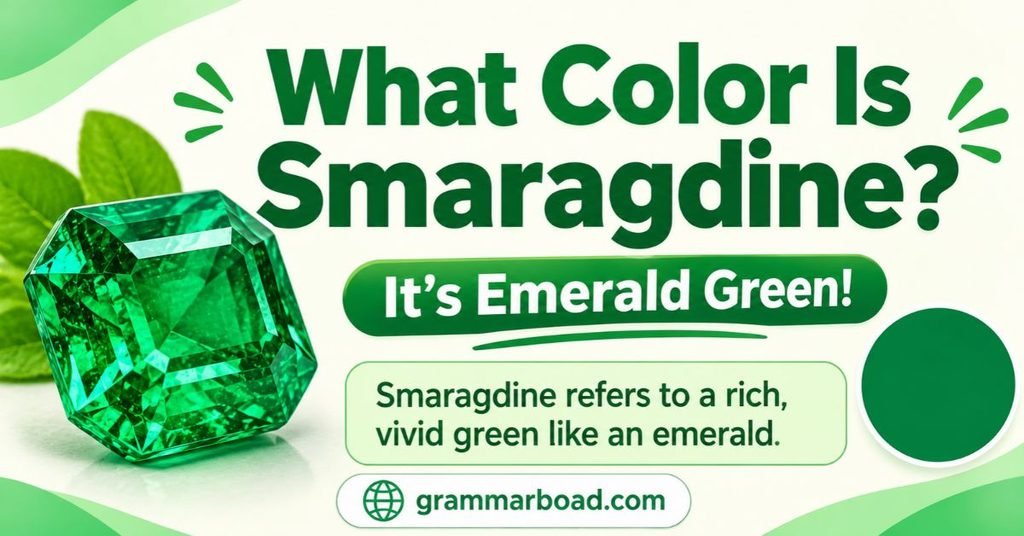
Smaragdine generally refers to emerald green, a rich and vivid green associated with the gemstone. Depending on the description, it may suggest a slightly cool or blue-toned green, but the word does not identify one exact standardized shade.
Think of a polished emerald reflecting light: its color is deep, bright, and luxurious. Writers use smaragdine to create a similar visual impression.
Is Smaragdine a Gemstone?
No. Smaragdine is not the name of a gemstone. It is an adjective that describes something related to emeralds or resembling their color.
A simple way to remember the difference:
- Emerald is the name of the gemstone and can also describe its green color.
- Smaragdine is an adjective meaning emerald-like or emerald-green.
The Origin of Smaragdine Meaning
The word smaragdine comes from Middle English smaragd and is derived from Latin smaragdinus. The Latin form comes from the Greek smaragdinos, which is related to smaragdos, meaning emerald.
The word has therefore retained a close connection with emeralds throughout its history. Its original sense is reflected in its modern definition: something belonging to, resembling, or having the color of an emerald.
The History of the Word Smaragdine
The word has a long history in English and classical languages. Dictionary records date its appearance in English to around 1350–1400. Its roots, however, go back to the Latin and Greek words associated with emeralds.
One famous related expression is Tabula Smaragdina, the Latin name for the Emerald Tablet. This historical text is associated with the alchemical tradition and is traditionally attributed to Hermes Trismegistus. Its earliest known versions appear in medieval Arabic sources, and it later became influential in European alchemical writing.
Over time, emerald became the familiar everyday English word for the gemstone, while smaragdine remained a rare, specialized adjective used mainly in literary and descriptive contexts.
Is Smaragdine Related to Emerald?
Yes. The two words are closely related through their historical roots.
Smaragdine comes from Latin smaragdinus, while emerald developed through Latin and Old French forms ultimately connected with Greek smaragdos. Although their modern spellings look different, both words are associated with the same gemstone.
The main difference is how they are used: emerald is a common noun and adjective, whereas smaragdine is a much rarer descriptive adjective.
British English vs American English Spelling
There is no standard spelling difference between British and American English. Smaragdine is spelled the same way in both varieties.
Unlike words such as colour/color or grey/gray, it does not have separate British and American spellings. The same spelling and basic meaning are used in standard English.
Which Spelling Should You Use?

Use smaragdine when you want to describe something that is emerald-like or emerald-green. The standard spelling ends in -ine and begins with sm-.
Avoid incorrect variations such as “smaragdyne” or “smargdine.” If your audience may not recognize the word, consider using the more familiar expression emerald-green instead.
How to Pronounce Smaragdine
A common English pronunciation of smaragdine is smuh-RAG-din. The stress falls on the second syllable.
You can break it into three parts:
- smuh – the soft opening sound
- RAG – the stressed middle syllable
- din – the final syllable
Pronunciation guides commonly give the form /sməˈræɡdɪn/. https://www.collinsdictionary.com/dictionary/english/smaragdine
Smaragdine Meaning in Different Contexts
The central meaning of smaragdine remains connected to emeralds, but its effect can change depending on the context.
- Descriptive writing: It describes a rich, emerald-like green color.
- Poetry: It creates vivid images of nature, light, or precious objects.
- Historical writing: It may appear in discussions of emeralds, classical languages, or alchemy.
- Creative writing: It adds an unusual and elevated tone to descriptions.
Smaragdine Meaning in Everyday Examples
You are unlikely to hear smaragdine in ordinary conversation, but you may encounter it in books, articles, and creative descriptions.
For example:
- A travel writer might describe a tropical bay as smaragdine.
- A book reviewer might praise the smaragdine imagery in a fantasy novel.
- A jewelry designer might use the word to describe an emerald-like shade.
- A fashion writer might describe a rich green silk dress as smaragdine.
These examples show how the word can make descriptions more vivid and distinctive.
Examples of Smaragdine in Sentences
Here are some examples showing how to use smaragdine correctly:
- The valley opened into a smaragdine carpet of moss and ferns.
- She wore a smaragdine silk gown that caught the light in the room.
- The poet described the sea as smaragdine at dawn and silver by noon.
- A smaragdine beetle crawled across the leaf, almost invisible against the green.
- The jeweler displayed a pendant with a beautiful smaragdine appearance.
Each sentence uses the word as an adjective to describe an emerald-like color or appearance.
Smaragdine Meaning in Nature and Art
Nature provides many examples of emerald-like colors, including rainforest canopies, tropical waters, moss-covered stones, and the shiny shells of certain beetles.
Artists and designers may use smaragdine to describe a rich green tone in paintings, jewelry, glass, textiles, or landscape designs. The word helps create an impression of depth, brightness, and natural beauty.
Smaragdine Meaning in Descriptive Writing
In descriptive writing, smaragdine works best when used sparingly. A single well-placed use can make a sentence more vivid, while repeating the word too often may make the writing sound overly elaborate.
Tip: Pair it with concrete nouns, such as smaragdine waters, smaragdine leaves, or smaragdine light, to help readers picture the color clearly.
Smaragdine Meaning in Literature
Writers who enjoy rich and classical vocabulary sometimes use smaragdine to create a sense of beauty, mystery, or antiquity.
It can work particularly well in fantasy stories, historical fiction, and lyrical poetry, where unusual descriptive words help establish an elevated atmosphere. However, readers may need context to understand this uncommon adjective.
Smaragdine Meaning in Formal Writing
In formal or academic writing, smaragdine is most suitable when discussing gemstones, descriptive language, art history, or historical texts.
In general academic or professional communication, a simpler expression such as “emerald-green” is usually clearer. Choose smaragdine when its precise meaning and literary tone add value to the sentence.
Smaragdine Meaning in Emails

In most everyday and business emails, smaragdine may sound unnecessarily formal or unfamiliar. Simple language is usually more effective when communicating with colleagues, clients, or customers.
However, it can work in a creative or personal email, such as a message describing a piece of emerald-colored jewelry or a beautiful natural scene.
Smaragdine Meaning in News Writing
News writing generally favors clear and direct language, so smaragdine is uncommon in standard news reports.
You might encounter it in a feature article, travel story, or arts review where descriptive language is more appropriate. In most news contexts, “emerald-green” communicates the same idea more clearly.
Smaragdine Meaning on Social Media
On social media, smaragdine may appear in captions, aesthetic posts, and discussions among people who enjoy unusual vocabulary.
For example, someone sharing a photograph of a green landscape, a piece of jewelry, or an emerald-colored outfit might use the word to create a poetic effect. It can also be a fun choice for word-of-the-day posts.
Common Mistakes with Smaragdine Meaning
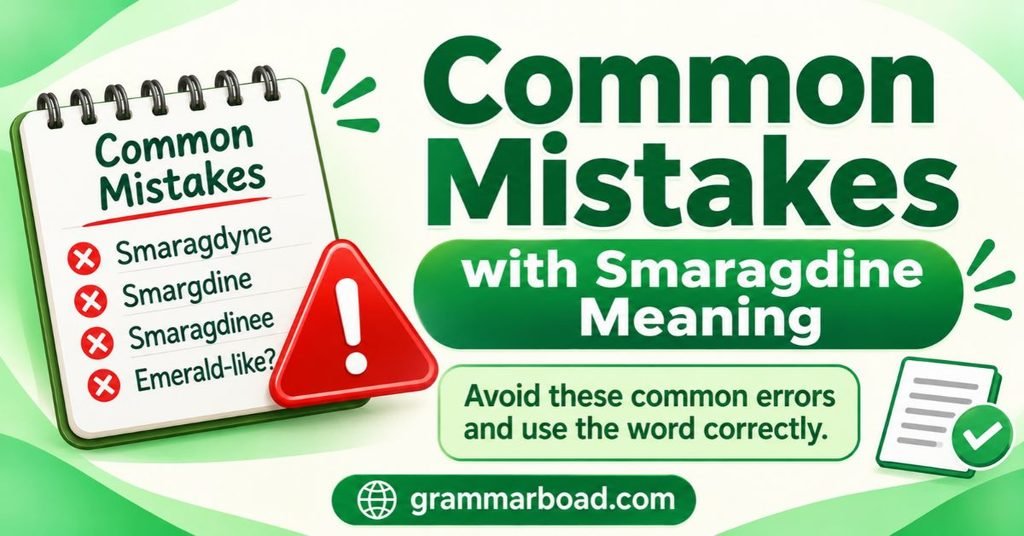
Here are some common mistakes to avoid when using the word:
- Treating it as a gemstone: Smaragdine is an adjective, not the usual name of a gemstone. The gemstone is called an emerald.
- Assuming it means every shade of green: It specifically suggests an emerald-like green.
- Misspelling the word: Forms such as “smaragdyne” and “smargdine” are incorrect. The standard spelling is smaragdine.
- Using it too frequently: Repeating a rare descriptive word can make writing feel unnatural.
- Using it without context: Some readers may not recognize the word, so a clearer alternative may be better in everyday communication.
Synonyms and Related Words for Smaragdine
Several words have meanings related to smaragdine, although they are not all exact synonyms.
- Emerald-green: A direct and familiar description of the color.
- Verdant: Describes something green with vegetation or lush growth.
- Viridian: Refers to a particular bluish-green color.
- Jade-green: Describes a green shade associated with jade.
- Beryl-green: Refers to a green shade associated with the mineral beryl.
- Jewel-green: A descriptive expression for a rich, gemstone-like green.
The best alternative depends on the context. Verdant emphasizes lush vegetation, while smaragdine focuses on an emerald-like color or quality.
Words Often Confused with Smaragdine
Some words look or sound similar to smaragdine or share a connection with emeralds. However, their meanings and uses differ.
- Smaragd: A rare or archaic noun referring to an emerald.
- Smaragdite: The name of a green mineral, not a general adjective for emerald-green.
- Emerald: The familiar name for the gemstone and its associated green color.
- Verdant: Describes lush greenery, especially vegetation.
- Viridian: Names a specific bluish-green color used in art and pigments.
Understanding these differences can help you choose the right word for your sentence.
Comparison Table
| Word | Part of Speech | Meaning | Typical Use |
| Smaragdine | Adjective | Of or relating to emeralds; emerald-green | Literary and descriptive writing |
| Emerald | Noun / Adjective | A gemstone or its green color | Everyday and general writing |
| Verdant | Adjective | Green with vegetation; lush | Nature writing |
| Viridian | Noun / Adjective | A specific bluish-green color | Art and painting |
Smaragdine Variations Comparison Table
| Term | Type | Notes |
| Smaragdine | Adjective | Standard spelling; means emerald-like or emerald-green |
| Smaragd | Noun | A rare or archaic word for emerald |
| Smaragdite | Noun | A name for a green mineral |
| Tabula Smaragdina | Latin phrase | The traditional Latin name for the Emerald Tablet |
Comparison Table: Smaragdine and Similar Green Shades
| Shade | Character | How It Differs from Smaragdine |
| Smaragdine | Rich, emerald-like green | Describes an emerald-related or emerald-green appearance |
| Emerald green | Vivid, jewel-like green | The familiar modern expression |
| Jade green | Often softer or more muted green | Associated with jade rather than emerald |
| Viridian | Cool, bluish green | Has a more noticeable blue undertone |
| Forest green | Deep, natural green | Usually darker and less jewel-like |
| Kelly green | Bright, strong green | Often appears more vivid and less subdued |
Smaragdine Meaning – Google Trends & Usage Data
Smaragdine is an uncommon English word, so it may attract interest from readers looking up unusual vocabulary, literary expressions, and gemstone-related terms.
Searches for phrases such as “smaragdine meaning” can help show what people want to learn about the word. However, search interest is not the same as overall word usage. For current search-interest information, check Google Trends directly and compare the results over a selected time period.
Is Smaragdine Used Today?
Yes, smaragdine is still used, but it is relatively rare. It may appear in literature, poetry, descriptive writing, and discussions involving emeralds or historical vocabulary.
It is not a common word in everyday conversation. Its uncommon nature makes it useful for writers who want a distinctive, literary way to describe an emerald-like color.
Is Smaragdine British or American English?
Smaragdine is used in both British and American English. Its standard spelling and basic meaning remain the same in both varieties.
There is no commonly recognized British or American spelling alternative for this word.
Can I Use Smaragdine in Everyday Writing?
Yes, you can, but consider your audience and purpose. In casual messages, business emails, or general explanations, “emerald” or “emerald-green” is usually easier to understand.
Use smaragdine when writing creatively, describing something in detail, or discussing literature, gemstones, and historical language. A little context can help readers understand this unusual word.
Also Read This:https://grammarboad.com/roll-call-or-role-call/
FAQs
What does smaragdine mean?
Smaragdine means of or relating to emeralds, or having an emerald-green color. It is an adjective used mainly in descriptive and literary writing.
Is smaragdine a real word?
Yes. Smaragdine is a recognized English adjective with roots in Latin and Greek. It has been recorded in English since the Middle English period.
How do you pronounce smaragdine?
A common pronunciation is smuh-RAG-din, with the stress on the second syllable.
Is smaragdine the same as emerald?
They are closely related but are not interchangeable in every sentence. Emerald is the name of the gemstone and its color, while smaragdine is an adjective describing something emerald-like.
Where does the word smaragdine come from?
It comes from Middle English smaragd and Latin smaragdinus, which is related to the Greek word smaragdos, meaning emerald.
Is smaragdine used differently in British and American English?
No. The spelling and basic meaning are the same in both varieties of English.
What is the Smaragdine Table?
The Smaragdine Table, also called the Tabula Smaragdina or Emerald Tablet, is a historical text associated with the alchemical tradition and traditionally attributed to Hermes Trismegistus.
Can smaragdine describe things other than color?
Yes. Although it most commonly describes an emerald-like color, it can also mean relating to or associated with emeralds.
Conclusion
Smaragdine is a rare, literary word meaning emerald-green or relating to emeralds. It comes from historical Greek and Latin forms connected with the word emerald and has been part of English since the Middle English period.
The word is spelled the same way in British and American English and is mainly used in descriptive, literary, and historical contexts. Although “emerald-green” is usually clearer in everyday communication, smaragdine can add a distinctive touch to creative writing when used appropriately.









1 thought on “Smaragdine Meaning: 5 Fascinating Facts & Origins”