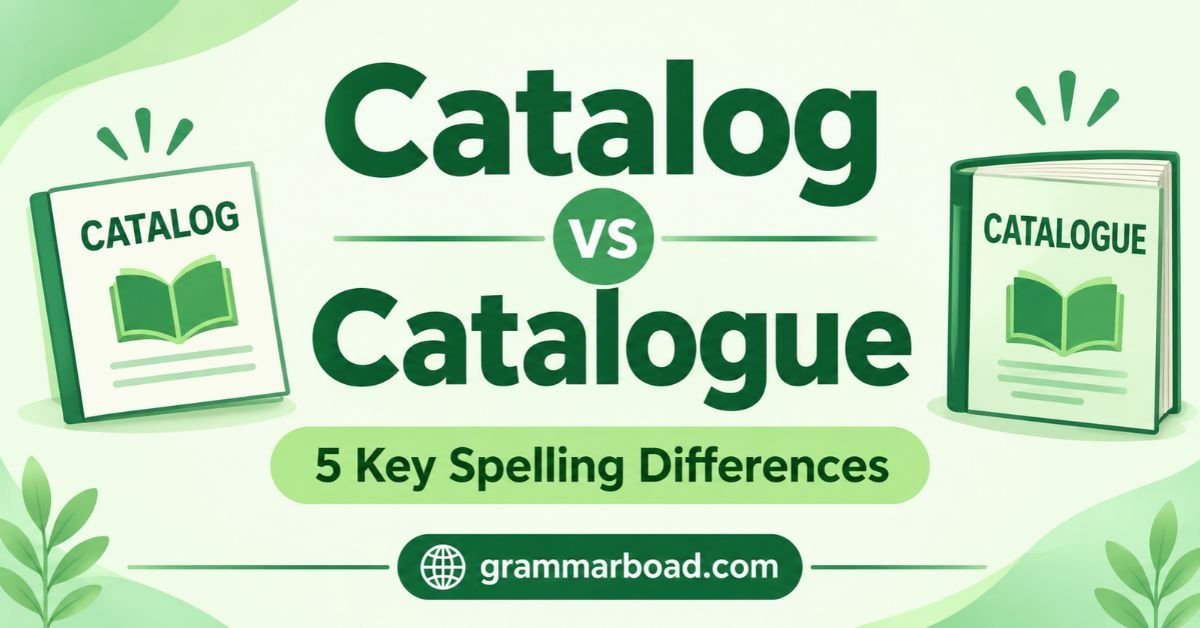
Catalog vs catalogue is one of those spelling questions that can confuse even confident writers. Both words refer to the same thing: a list or collection of items. However, their spelling differs depending on the region and the type of English being used.
The short answer is that “catalog” is the standard American English spelling, while “catalogue” is the standard British English spelling. Both forms are correct and have the same meaning.
Understanding Catalog vs Catalogue is important for writers who want to follow the correct American or British English spelling. Although both forms have the same meaning, choosing the right spelling helps keep your writing clear and consistent for your intended audience.
This guide explains the five key differences between catalog and catalogue, including their regional preferences, verb forms, pronunciation, usage, and spelling history. You will also learn which spelling to choose for your writing.
Catalog vs Catalogue: At a Glance
| Feature | Catalog | Catalogue |
|---|---|---|
| Main region | United States | United Kingdom |
| Other regions | Common in American-influenced technical writing | Australia, New Zealand, Ireland, and generally Canada |
| Meaning | A list or collection of items | The same |
| Past tense | Cataloged | Catalogued |
| -ing form | Cataloging | Cataloguing |
| Pronunciation | KAT-uh-log | KAT-uh-log |
| Usage | Standard American spelling | Standard British spelling |
Both spellings are correct. The main difference is regional preference and the spelling conventions followed by different English-speaking countries.
5 Key Differences Between Catalog and Catalogue
When comparing Catalog vs Catalogue, both spellings refer to the same word, but their usage differs according to regional English conventions. Understanding these five key differences will help you choose the correct form for your audience.
1. Regional Spelling Preferences
The biggest difference is where each spelling is commonly used.
- Catalog: Preferred in American English and commonly used in American business and technology.
- Catalogue: Preferred in British English and widely used in Australia, New Zealand, and Ireland.
Canadian English generally favors “catalogue” in traditional writing, although “catalog” also appears, particularly in technical contexts.
2. Verb Forms
Both words can function as verbs, but their past-tense forms follow different regional spelling conventions.
- American English: Cataloged
- British English: Catalogued
For example:
- The librarian cataloged all the new books.
- The librarian catalogued all the new books.
Both sentences are correct. The spelling depends on the English variant being used.
3. The -ing Form
The same spelling difference appears when adding “-ing” to the verb.
- American English: Cataloging
- British English: Cataloguing
Examples:
- Cataloging historical documents requires attention to detail.
- Cataloguing historical documents requires attention to detail.
Both forms are accepted, but each is associated with a different regional spelling preference.
4. Usage in Different Fields
The two spellings also appear in different professional and academic settings.
- Catalog: Frequently used in American businesses, online shopping platforms, software, and database systems.
- Catalogue: Common in British publishing, libraries, museums, galleries, and retail businesses.
For example, a US-based online store may use “product catalog,” while a British retailer may use “product catalogue.”
5. Appearance and Writing Style
The most noticeable visual difference is the “-ue” ending in catalogue.
“Catalog” has a shorter and simpler appearance, while “catalogue” follows the traditional British spelling pattern.
However, neither spelling is more formal or professional than the other. Both are appropriate when used according to the relevant regional spelling conventions.
Is “Catalog” or “Catalogue” Correct?
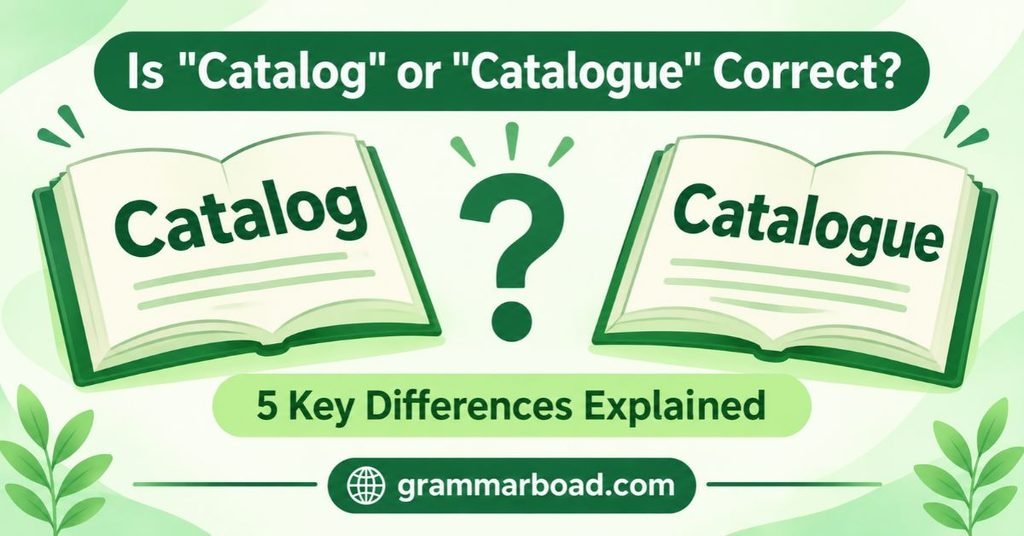
Both are correct. They are two accepted spellings of the same word, not examples of a correct and incorrect spelling.
The right choice depends on your audience and the type of English you are using.
- American English: Our product catalog is updated every spring.
- British English: Our product catalogue is updated every spring.
Neither sentence contains a spelling mistake. The important thing is to maintain consistency throughout your writing.
The choice between Catalog vs Catalogue depends on whether you are following American or British English. Both spellings are correct, so neither should be considered a spelling mistake when used in the appropriate regional context.
What Does “Catalog” Mean?
“Catalog” is both a noun and a verb in American English.
As a noun, it means an organized list or collection of items, usually containing descriptions or other useful information. It can refer to a printed booklet, an online shopping section, or a searchable database.
Examples:
- The online catalog lists every title available in the library.
- She flipped through the seed catalog to find different varieties of tomatoes.
- The company released its new product catalog last month.
As a verb, catalog means to record, organize, or list items systematically.
Examples:
- The museum staff will catalog the donated paintings this week.
- The librarian needs to catalog the new books before placing them on the shelves.
In American English, “catalog” is the standard spelling for both uses.
What Does “Catalogue” Mean?
“Catalogue” has exactly the same meanings as “catalog.” It can be used as both a noun and a verb in British English.
As a noun, it describes an organized list or collection of items. As a verb, it means to arrange, record, or document things systematically.
Examples:
- The auction house published a catalogue of the items available for sale.
- The university provides a detailed course catalogue for new students.
- He spent the weekend cataloguing his vinyl records.
The main difference is the additional “-ue” at the end. This spelling is traditionally used in British English.
Cataloged vs Catalogued: Which Is Correct?
Both “cataloged” and “catalogued” are correct past-tense forms of the verb.
The preferred spelling depends on the regional English variant.
- Cataloged: The standard American English spelling.
- Catalogued: The standard British English spelling.
Examples:
- The librarian cataloged every new arrival. (American English)
- The librarian catalogued every new arrival. (British English)
If you are unsure which form to use, match the verb to your chosen regional spelling.
For example, if you use “catalog” as a noun, “cataloged” is generally the more consistent choice. If you use “catalogue,” choose “catalogued.”
Cataloging vs Cataloguing
The same spelling pattern applies to the “-ing” form.
- Cataloging: Standard American English.
- Cataloguing: Standard British English.
Examples:
- Cataloging the historical archive took several months.
- Cataloguing the historical archive took several months.
Both sentences are grammatically correct.
You may also encounter “cataloguing” in American writing, particularly in library and archival contexts. However, “cataloging” remains the more common American spelling.
How Do You Pronounce Catalog and Catalogue?
Both words have essentially the same pronunciation: KAT-uh-log.
The additional “-ue” in “catalogue” is silent, so it does not create a noticeable difference in pronunciation.
Some speakers may pronounce certain vowels slightly differently depending on their regional accent. However, the two spellings are generally pronounced alike.
This means you cannot usually identify which spelling someone is using simply by listening to the word.
Where Are Catalogs and Catalogues Used?
The choice between catalog and catalogue largely depends on regional spelling conventions.
Here is how the two forms are generally used in different English-speaking countries.
The choice between Catalog vs Catalogue also depends on the location of the business or organization. American companies generally use catalog, while British businesses commonly prefer catalogue in their publications and product listings.
- United States: “Catalog” is the standard spelling in everyday writing, business, education, and technology.
- United Kingdom: “Catalogue” is the preferred spelling in publishing, retail, libraries, and general writing.
- Canada: “Catalogue” is generally preferred in traditional Canadian English, although “catalog” is also used, especially in technical fields.
- Australia: “Catalogue” is the standard spelling.
- New Zealand: “Catalogue” is generally preferred.
- Ireland: “Catalogue” is the usual spelling.
Professional context can also influence spelling choices. For example, software platforms and database systems may use “catalog” because of American English conventions, even when their users are located in other countries.
Can “Catalog” or “Catalogue” Mean a Long List?
Yes. Both words can also describe a long or detailed list of things, especially when referring to complaints, mistakes, achievements, or events.
In this figurative sense, the word suggests a collection or series of related items rather than a physical booklet.
Examples:
- She presented a catalogue of complaints about the company’s customer service.
- The investigation revealed a catalog of errors that caused the project to fail.
- The report included a catalogue of achievements from the previous year.
Both spellings work in this context. Choose the form that matches your regional English preference.
Why Does One Word Have Two Spellings?
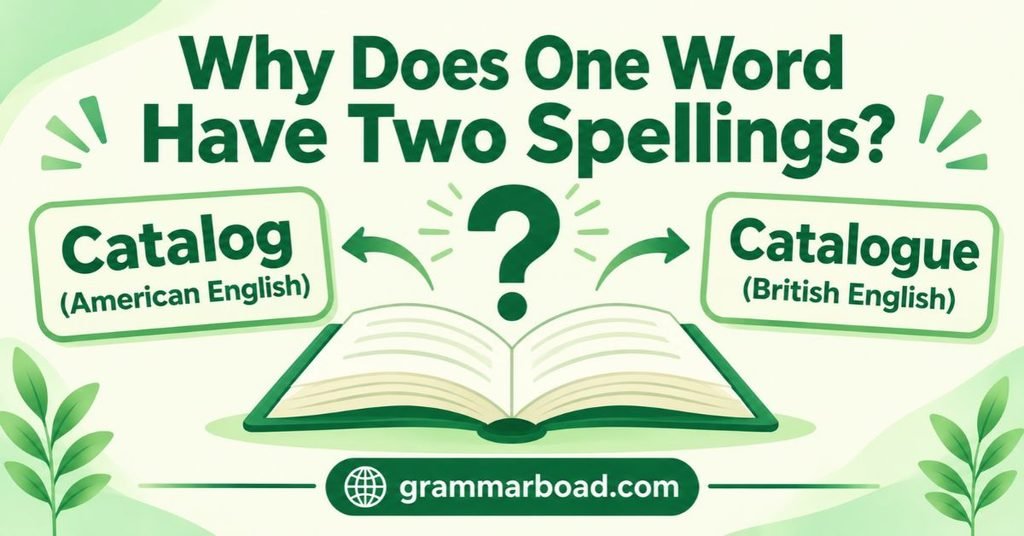
The word “catalogue” has a long history. It ultimately comes from the Greek word “katalogos,” meaning a list or register, and entered English through Latin and French.
Historically, English writers commonly used the longer “-ogue” ending. Over time, American English developed a preference for certain simplified spellings, including “catalog.”
American spelling reformers, particularly Noah Webster, helped popularize simpler spelling conventions in the United States. As a result, “catalog” became the standard American form, while British English retained “catalogue.”
The same spelling pattern can be seen in other word pairs, such as:
- Dialog and dialogue
- Analog and analogue
- Prolog and prologue
These examples show how American and British English sometimes use different spellings for the same words.
Is “Catalogue” More Formal Than “Catalog”?
No. Neither spelling is more formal or professional than the other.
The difference is mainly regional rather than stylistic.
In American English, “catalog” is the ordinary spelling used in everyday communication, academic writing, and business documents.
In British English, “catalogue” is equally common and natural.
Although some American readers may consider “catalogue” more traditional in appearance, this does not make it more formal. Both forms are appropriate for professional and academic writing when used consistently.
Which Spelling Should You Use?

Choosing between catalog and catalogue is simple when you consider your target audience.
Follow these guidelines:
- Writing for American readers? Use catalog, cataloged, and cataloging.
- Writing for British readers? Use catalogue, catalogued, and cataloguing.
- Writing for Australian or New Zealand readers? Generally use catalogue, catalogued, and cataloguing.
- Following a publisher’s style guide? Always follow its preferred spelling.
- Writing for an international audience? Choose one spelling system and use it consistently.
A helpful tip is to set your preferred English language variant in your word processor. This can help identify spelling inconsistencies before publishing your content.
Catalog or Catalogue for SEO: Does It Matter?
When using Catalog vs Catalogue in SEO content, choose the spelling that best matches your target audience and keyword research. Both variations have the same meaning, but regional search preferences may influence which version is more suitable for your website.
However, your choice should reflect the language and search habits of your target audience.
Consider these points:
- If your website mainly targets American readers, “catalog” is the more natural primary spelling.
- If your audience is mainly in the UK, Australia, or New Zealand, “catalogue” may be more appropriate.
- Use your chosen spelling consistently in your title, headings, and main content.
- You can mention the alternative spelling naturally when explaining the difference between the two words.
Search engines can generally understand closely related spelling variations, but you should still consider search intent and keyword research when choosing your primary keyword.
Avoid inserting both spellings repeatedly just to target additional searches. For Catalog vs Catalogue, using the spelling that matches your main audience is a practical way to keep your SEO content relevant and consistent. Natural, useful content is more important than unnecessary keyword repetition.
Common Catalog and Catalogue Combinations
Both spellings appear in several common English expressions. Their meanings remain the same, but their spelling should match your chosen English variant.
When learning Catalog vs Catalogue, it is helpful to recognize common phrases such as product catalog, library catalog, product catalogue, and online catalogue. These expressions follow the same regional spelling preferences.
- Product catalog / Product catalogue: An organized list of products sold by a business.
- Online catalog / Online catalogue: A digital collection of products, services, or information.
- Library catalog / Library catalogue: A searchable list of books and other materials available in a library.
- Course catalog / Course catalogue: A list of courses offered by a school, college, or university.
- Catalog of errors / Catalogue of errors: A detailed list of mistakes or problems.
- Exhibition catalogue: A publication containing information about an art exhibition.
- Back catalog / Back catalogue: An artist’s or company’s previously released work or products.
These combinations are useful in everyday, academic, and professional writing.
Common Mistakes to Avoid
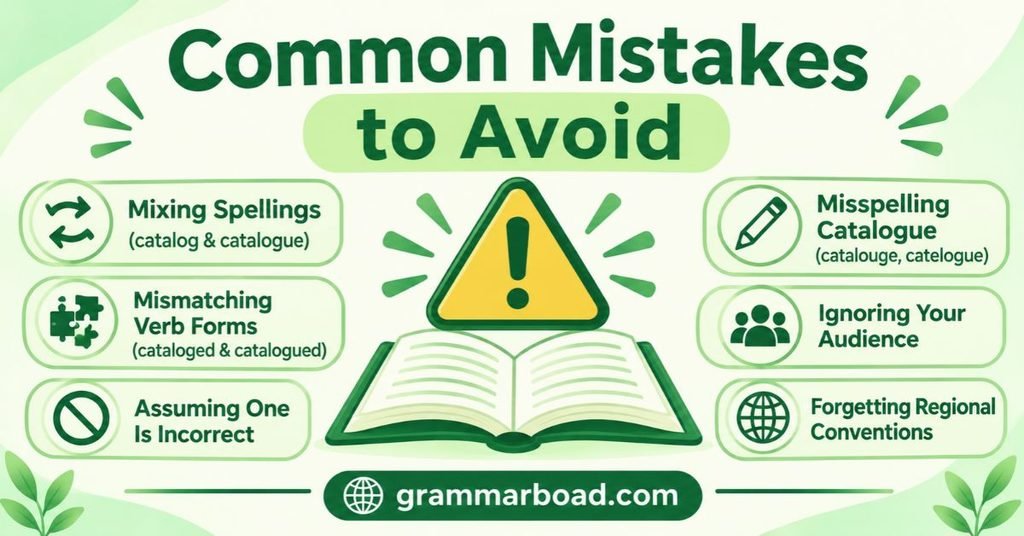
Although catalog and catalogue are both correct, writers sometimes make mistakes when choosing between them.
Here are some common errors to watch out for:
One common mistake when using Catalog vs Catalogue is assuming that one spelling is incorrect. Both are accepted forms, but writers should avoid switching between American and British spellings in the same article.
- Mixing spellings in one document: Using “catalog” in the introduction and “catalogue” later can make your writing look inconsistent.
- Mismatching verb forms: Pairing “catalogue” with “cataloged” or “catalog” with “cataloguing” can create unnecessary spelling inconsistencies.
- Assuming one spelling is incorrect: Neither form is wrong. Both are accepted English spellings.
- Misspelling catalogue: Common errors include “catalouge” and “catelogue.” The correct spelling is “catalogue.”
- Ignoring your target audience: Using American spelling in content specifically written for British readers, or the reverse, may make your writing feel less natural.
- Forgetting regional spelling conventions: Always consider whether your content follows American or British English.
Avoiding these mistakes will help make your writing clearer and more professional.
Also Read This:https://grammarboad.com/among-or-amongst/
Catalog or Catalogue: Quick Decision Guide
If you are still unsure which spelling to choose, use this simple decision guide.
- Who is your audience? Choose “catalog” for American readers and “catalogue” for British and most Commonwealth readers.
- Are you following a style guide? Use the spelling recommended by your publisher, organization, or educational institution.
- Are you using a verb form? Match the spelling to your chosen variant: cataloged/cataloging or catalogued/cataloguing.
- Have you maintained consistency? Check your entire document to make sure you have not mixed regional spellings.
When in doubt, choose the spelling your target readers are most familiar with and use it throughout your writing.
FAQs
1. Is “catalogue” a British word?
Yes. “Catalogue” is the standard British English spelling. It is also commonly used in Australia, New Zealand, and Ireland. American readers understand it, but they generally prefer “catalog.”
2. Can I use “catalog” in British English?
Yes. British readers can understand “catalog,” but “catalogue” is the preferred spelling in standard British English. Some technical fields may use “catalog” regardless of regional preference.
3. Is “cataloguing” correct in American English?
Yes. “Cataloguing” does appear in American English, particularly in library and archival contexts. However, “cataloging” is the more common American spelling.
4. Do catalog and catalogue have different meanings?
No. Both words have identical meanings. They can refer to an organized list or collection of items and can also be used as verbs meaning to record or organize information.
5. Which spelling is better for a website?
Choose the spelling that matches your target audience. Use “catalog” for an American audience and “catalogue” for a British or Commonwealth audience. Consistency is important for a professional website.
6. Is catalog a shortened form of catalogue?
“Catalog” is a simplified spelling rather than an abbreviation. It became the standard American form, while “catalogue” remained common in British English.
7. What is the plural of catalog and catalogue?
The plural forms are “catalogs” and “catalogues,” respectively. Both mean more than one list or collection.
8. What is the difference between cataloged and catalogued?
“Cataloged” is the standard American past-tense spelling, while “catalogued” is the standard British form. Both have the same meaning.
9. What is the main difference between catalog vs catalogue?
The main difference between catalog vs catalogue is regional spelling. “Catalog” is standard in American English, while “catalogue” is preferred in British English and several Commonwealth countries. Both words have the same meaning and pronunciation.
Conclusion
Catalog and catalogue are two correct spellings of the same English word. The main difference is regional preference: “catalog” is standard in American English, while “catalogue” is preferred in British English and many Commonwealth countries.
When comparing Catalog vs Catalogue, remember that both forms have the same meaning, pronunciation, and level of formality. The same spelling distinction applies to their verb forms, including cataloged and catalogued, as well as cataloging and cataloguing.
The key to using Catalog vs Catalogue correctly is understanding your audience and choosing the spelling that feels natural to your readers. Consistent spelling also makes your content easier to read and understand.
Choose the spelling that matches your target audience, follow the appropriate regional conventions, and maintain consistency throughout your writing. This simple approach will help you use catalog or catalogue correctly in everyday, academic, and professional content.